


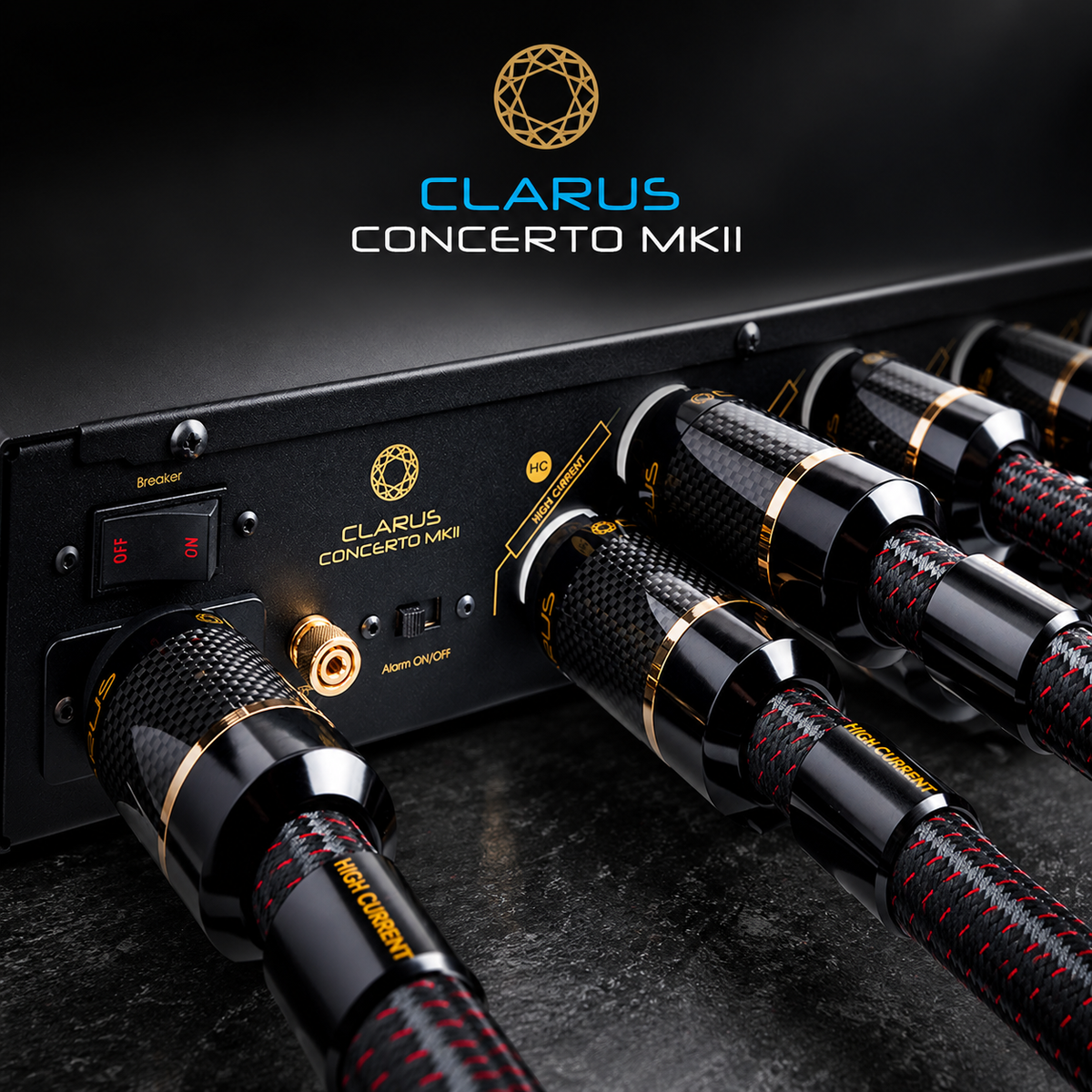
The Clarus Concerto MKII: Your System Is Only as Good as the Power Feeding It
We spend a lot of time talking about speakers, amplifiers, DACs, streamers and cables at The Grid. Power conditioning isn't nearly as exciting, and it certainly isn't the first thing most people want to spend money on. But once you get into a really good system, power starts to matter.
Think about what your system is plugged into. The same electrical service is running your HVAC, refrigerators, LED lighting, computers, chargers, appliances and who knows what else. Then we're asking a highly resolving audio system to pull clean, consistent power from that environment.
That's where something like the Clarus Concerto MKII starts to make sense.
Power conditioners have always been a slightly controversial subject in high-end audio, especially when it comes to amplifiers. Cleaning up noise is great, but not if the conditioner restricts current and takes away some of the dynamics and punch you bought that big amplifier for in the first place.
Clarus seems to understand that.
The Concerto MKII isn't designed around running every component through the exact same filtering circuit. Its eight 20-amp outlets are divided into analog, digital and high-current sections, with the filtering designed around what you're actually plugging into them.
That distinction is important.
A DAC or streamer is a very different electrical load than a preamp, and both are very different from a large power amplifier. Digital components can also introduce high-frequency noise of their own, so the Concerto has two independently filtered digital banks that keep those components separated from the analog and high-current sections.
Then you have the high-current outlets.
This is probably the part we're most interested in at The Grid because we regularly have systems running some very serious amplification. The Concerto MKII uses a full 20-amp internal architecture, and Clarus designed the high-current section specifically for amplifiers, powered speakers, subwoofers and other equipment that can demand a lot of current very quickly.
On a proper 20-amp circuit, you're talking about as much as 2,400 watts of available power compared with 1,800 watts from a typical 15-amp circuit.
Inside, Clarus uses heavy copper bus bars, a 30-amp high-current inductor, oil-filled capacitors and its FluxCore filtering technology. There is also a star-ground system with isolated-ground outlets to help keep noise from moving between connected components.
That's a lot of engineering, but ultimately we don't care how complicated the inside of a power conditioner is if we can't hear what it does.
And apparently we're not the only ones.
Jeff Dorgay recently reviewed the Concerto MKII for TONE, and his experience with it is worth reading. He ended up giving it a Product of the Year award and, maybe more importantly, bought the review sample.
That's about as good an endorsement as you can get from a reviewer.
What we look for with good power conditioning isn't some dramatic change in the personality of a system. In fact, we don't want that. If you've spent the time and money putting together the right speakers, amplification and source components, you presumably already like how your system sounds.
What you want is less getting in the way of it.
A lower noise floor can make small details easier to hear. The space around instruments can become more apparent. Backgrounds can seem quieter and the presentation a little more relaxed and organized. With a properly designed conditioner, you should be getting those benefits without losing the dynamics and impact of the system.
There is also the less glamorous issue of protecting everything connected to it.
The Concerto MKII monitors incoming voltage and can shut the system down if voltage drops below 90 volts or rises above 135 volts, reconnecting when the incoming power returns to a safe range. It also incorporates surge suppression, thermal protection and a hydraulic-magnetic circuit breaker.
When you've got a substantial amount of money sitting in a rack, that part starts looking pretty attractive too.
So, does every audio system need a Concerto MKII?
Probably not.
If you're just getting started, we'd tell you to put your money into the fundamentals first. Get the speakers right. Get the amplification right. Get the room and speaker placement right.
But when you're dealing with a highly resolving system and you're trying to get everything out of the equipment you've already invested in, power becomes another part of the equation.
That's really where we see the Concerto MKII fitting.
And power conditioning is one of those things we'd much rather demonstrate than debate. Put it into a good system, listen for a while, and then take it back out. That's a lot more useful than arguing about it on the internet.
If you're curious about what the Clarus Concerto MKII can do in your system, come see us at The Grid or give us a call. We can also look at the bigger picture—dedicated circuits, power requirements, amplification and how everything in the system is connected.
Share:
Focal Mu-so Hekla Wins EISA “Best Immersive Audio System 2026–2027”
Stereophile Reviews the LUXMAN L-100 Centennial: The Best Yet?