


How to Choose a Streaming DAC Without Losing Your Mind
Streaming music should be simple.
Pick a song. Press play. Enjoy.
Then you decide you want it to sound really good.
Suddenly you're reading about DAC architectures, network transports, master clocks, local caching, upsampling, Roon, proprietary apps, separate power supplies and whether your Ethernet cable has somehow become part of the conversation.
Welcome to the wonderful world of high-end digital audio.
The good news? Building a great streaming system doesn't have to be complicated. And despite what a few late-night audio forums might have you believe, you don't necessarily need six boxes and a shelf full of accessories to make Spotify, TIDAL or Qobuz sound fantastic.
You just need to understand what you're actually buying.
First: What Exactly Is a Streaming DAC?
Let's separate two jobs that are often combined into one component.
A network streamer gets the music into your system. It connects to your network and accesses music from streaming services, local servers or other digital sources.
A DAC — digital-to-analog converter — takes that digital information and converts it into the analog signal your amplifier can actually use.
A streaming DAC does both jobs in one chassis.
Simple enough.
Except there is absolutely no requirement that those two jobs happen in the same box.
And that's where things get interesting.
Option 1: Keep It Simple
For a lot of systems, a high-quality streaming DAC is the answer.
One component can potentially handle your streaming, digital conversion and, depending on the model, volume control or preamplifier duties.
That means fewer boxes, fewer cables, fewer power cords and considerably fewer opportunities to wonder whether you bought the wrong thing at 2:00 in the morning.
More importantly, today's best streaming DACs aren't merely convenience products.
They're serious high-end sources.
Brands like Naim have spent years refining the relationship between streaming hardware, software, power supplies and digital conversion. Instead of assembling a system from several unrelated components, you're buying a multiroom ecosystem engineered to work together.
For the right system, that's incredibly compelling.
And there is something refreshing about walking into the room, opening an app, choosing an album and listening to music instead of administering a small data center.
Option 2: Separate the Streamer and DAC
Now we're entering dangerous territory.
Because once you discover separates, it's very easy to start thinking:
"If two boxes are better than one, perhaps four boxes are better than two."
Sometimes they are.
Separating the network streamer from the DAC gives you considerably more flexibility.
You might use a dedicated Aurender network transport to handle streaming and music management, then send the digital signal to a completely separate DAC.
Why?
Because the manufacturer of the streamer can concentrate on streaming. The DAC manufacturer can concentrate on digital conversion. And you can choose exactly the combination you want.
It also gives you an easier upgrade path.
Love your DAC but want a newer streaming platform?
Change the streamer.
Love your streamer but want to move up to a reference DAC?
Change the DAC.
That's one reason separates remain extremely popular in serious digital systems.
Where Berkeley Audio Design Fits In
Berkeley Audio Design is an interesting example because it doesn't try to give you everything in one box.
Berkeley builds DACs.
Very, very good DACs.
That means a Berkeley-based streaming system requires a separate network source or transport. Pairing a dedicated streamer with a Berkeley DAC creates a fundamentally different architecture from buying an all-in-one streaming DAC.
Is that automatically better?
No.
And that's an important point.
High-end audio gets into trouble when different automatically becomes better.
The advantage is choice. You're selecting the streaming platform independently from the digital conversion, which allows the system to be tailored around your priorities and upgraded independently later.
For some listeners, that's exactly the point.
Then There Is dCS
At the upper end of digital playback, things get considerably more sophisticated.
dCS approaches digital audio as an entire system rather than simply putting a DAC chip inside a nice aluminum chassis.
Its products can involve proprietary digital conversion architecture, sophisticated processing, network playback and, depending on the system, dedicated clocking.
And yes, this is where digital audio can get expensive.
Very expensive.
But here's the part that's often lost when people discuss reference digital equipment online:
You have to hear what it does in an appropriately revealing system.
Looking at a specification sheet won't tell you what happens to the perceived depth of a recording, the space around instruments, low-level information or the natural decay of a piano note.
At this level, you're not paying $20,000 instead of $2,000 because one DAC has ten times the buttons.
You're chasing the last degrees of performance.
Whether those degrees matter to you is something you should determine with your ears rather than a forum.
So, Do You Actually Need an Expensive DAC?
Probably our favorite answer in high-end audio:
It depends.
If you're putting together a modest system, spending the majority of the budget on the digital source doesn't make much sense.
Put that money into better speakers. Better amplification. Proper setup. Room treatment.
Build a balanced system first.
But the equation changes when the rest of the system becomes sufficiently revealing.
Put a serious digital source in front of great amplification and highly resolving loudspeakers and differences that seemed relatively minor elsewhere can become surprisingly obvious.
That's why we don't believe components should be evaluated in isolation.
The question isn't:
"How good is this DAC?"
The better question is:
"What does this DAC do in this system?"
That's a much more useful conversation.
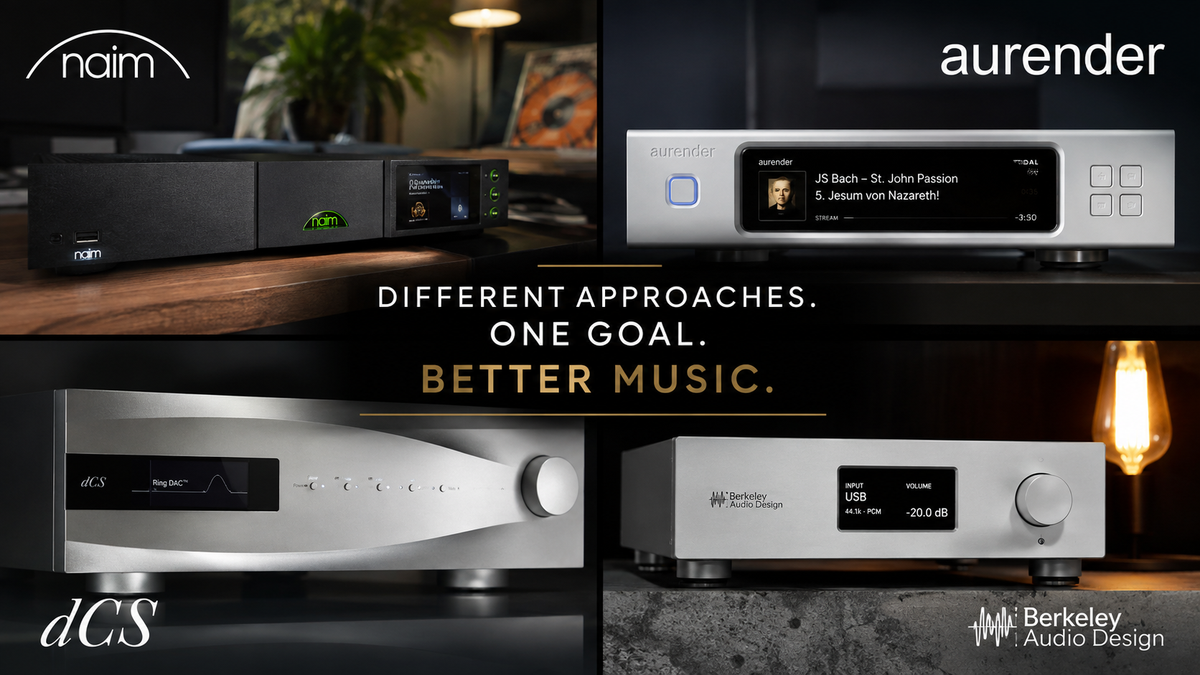
Naim, Aurender and dCS: Three Different Approaches
This is also why comparing high-end digital brands strictly by specifications doesn't tell you very much.
They aren't necessarily trying to solve the problem the same way.
Naim makes a strong argument for integration. Hardware, software, streaming and digital conversion can operate as part of a tightly controlled ecosystem. If you want exceptional performance without turning your equipment rack into a science experiment, that's attractive.
Aurender has built its reputation around dedicated digital music playback. Its lineup gives you options ranging from network transports designed to feed an external DAC to models incorporating digital conversion themselves. It's particularly appealing to listeners who want a purpose-built music server and streamer rather than using a general-purpose computer as their source.
dCS takes you further into reference digital playback, with sophisticated processing, proprietary conversion technology and system architectures that can expand as your system evolves.
None of these philosophies is universally "best."
They're answers to different questions.
And that distinction matters far more than which component won somebody's internet shootout.
What About Roon?
Roon deserves its own discussion, but it's worth mentioning because software matters.
A lot.
The interface you use to find and play music becomes part of your experience with the system every single day.
Some listeners love Roon. Others prefer the manufacturer's native app. Some want locally stored music integrated with streaming services. Others have completely abandoned local libraries and live almost entirely inside Qobuz or TIDAL.
Don't treat this as an afterthought.
A streaming system that sounds incredible but makes you hate finding music isn't a particularly good streaming system.
We'd rather see someone choose a platform they genuinely enjoy using.
Because here's a revolutionary concept:
Your stereo is supposed to make you want to listen to music.
Do You Need a Master Clock?
Here we go.
Clocks.
This is usually the point where normal people leave the room.
A digital audio system depends on extremely precise timing. In certain high-end architectures, an external master clock can further improve how multiple digital components operate together.
Does every streaming system need one?
Absolutely not.
Should you automatically buy one because there's an empty shelf on your rack?
Also no.
But within digital systems designed to take advantage of external clocking, it can become another meaningful step toward extracting maximum performance.
This is firmly in listen first, buy second territory.
One Box or Several?
Here's the easiest way to think about it.
If you value simplicity, start by looking at a high-quality integrated streaming DAC.
If you value flexibility and upgradeability, consider separating the network streamer from the DAC.
If you're building a reference digital system, then dedicated transports, DACs, clocks and other components may become part of the conversation.
There isn't a trophy for owning the most boxes.
The goal is better music.
The Part the Internet Can't Do for You
You can research digital audio for months.
You can compare specifications.
You can watch reviews.
You can read 147 pages of an argument between two strangers about clocking.
Eventually, you still have to listen.
At The Grid HiFi, we work with Naim, Aurender, dCS and Berkeley Audio Design, which gives us the ability to demonstrate very different approaches to high-end digital playback in real systems.
That's important because choosing a digital source isn't just about picking the "best DAC."
It's about finding the right architecture for your system, your listening habits and your budget.
Sometimes that's one box.
Sometimes it's two.
Sometimes things get a little out of control.
We're okay with that too.......
Share:
The Science Behind Audiophile-Grade Sound Quality
The Million-Dollar Amplifier: Inside the Goldmund Telos 9800