


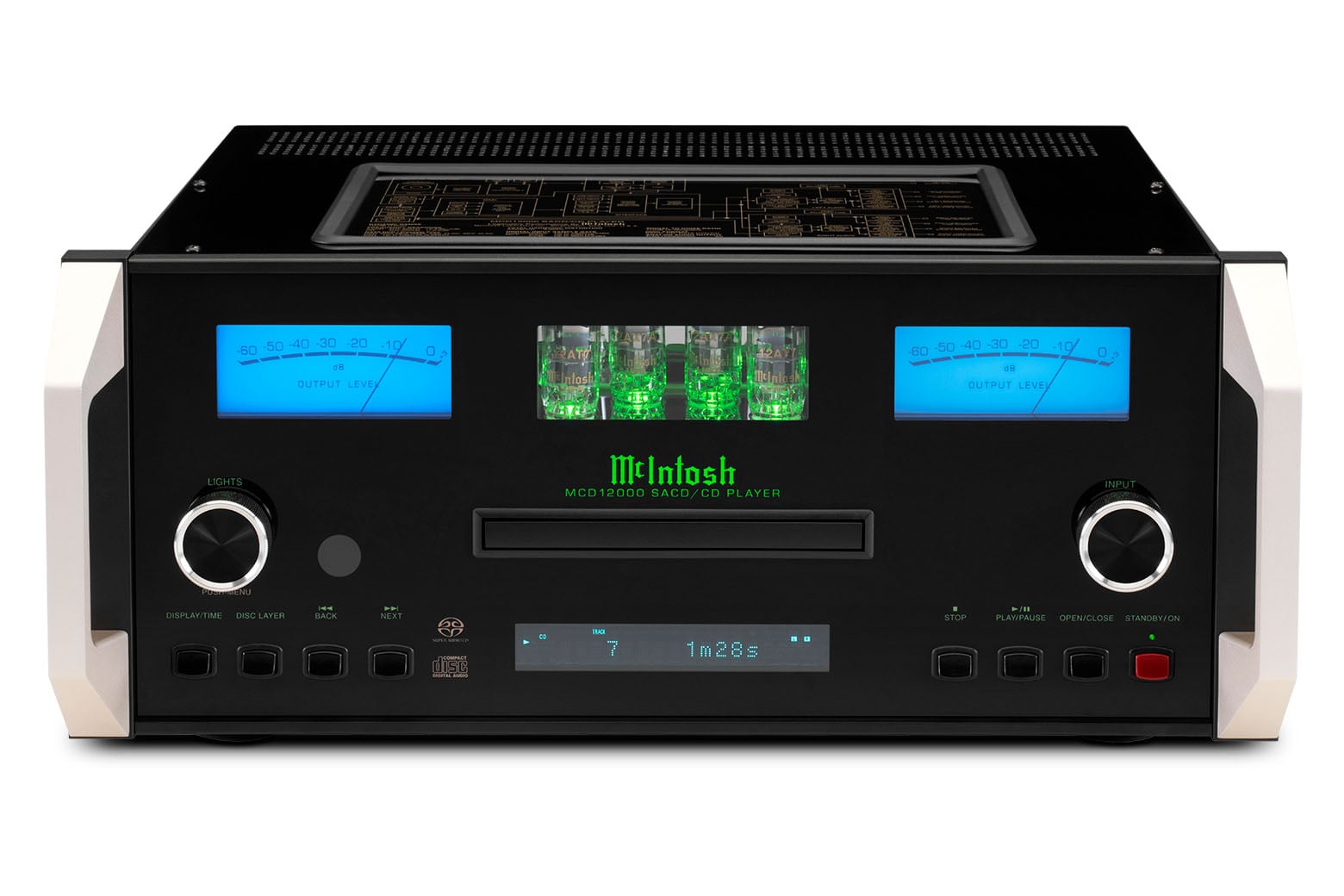
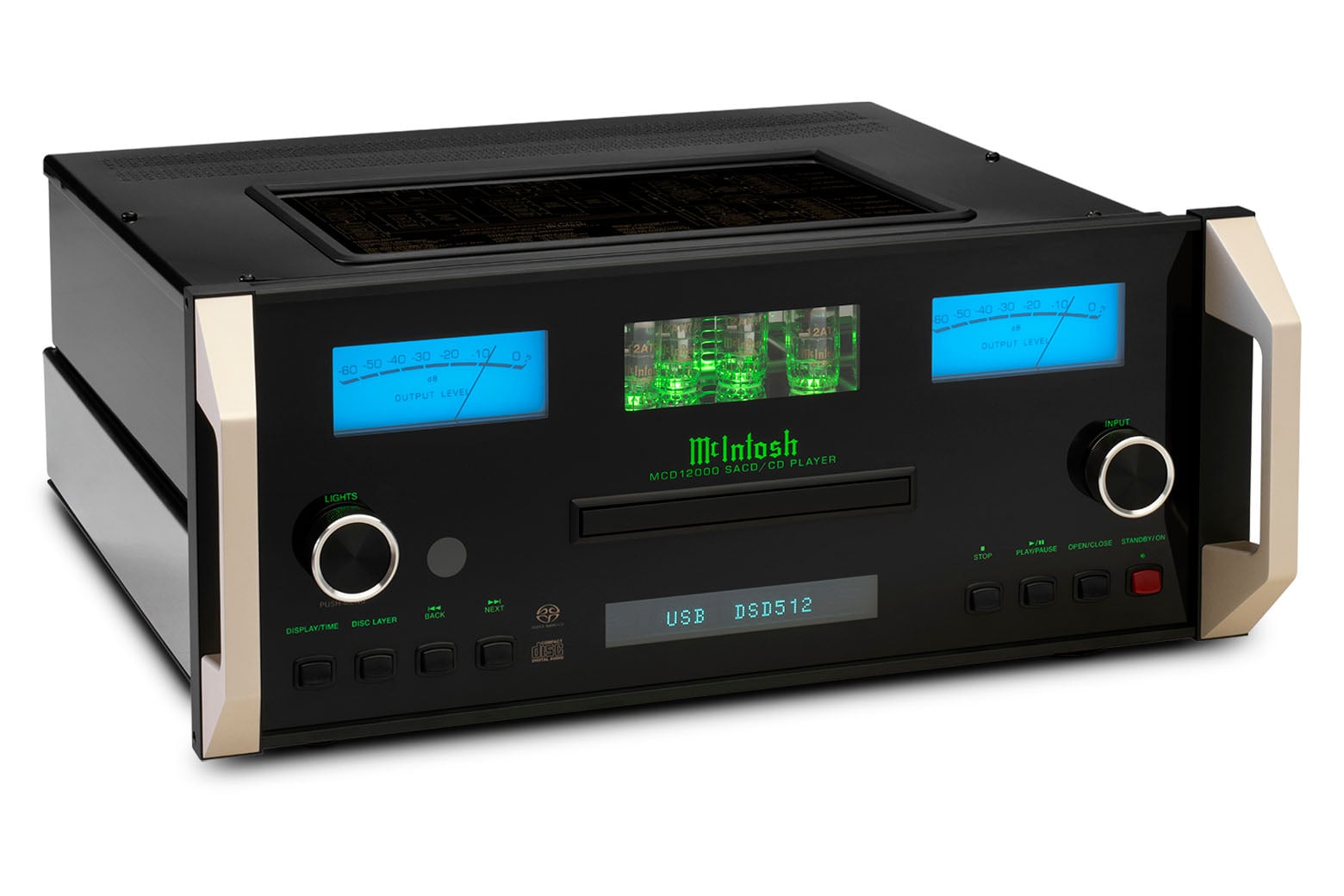
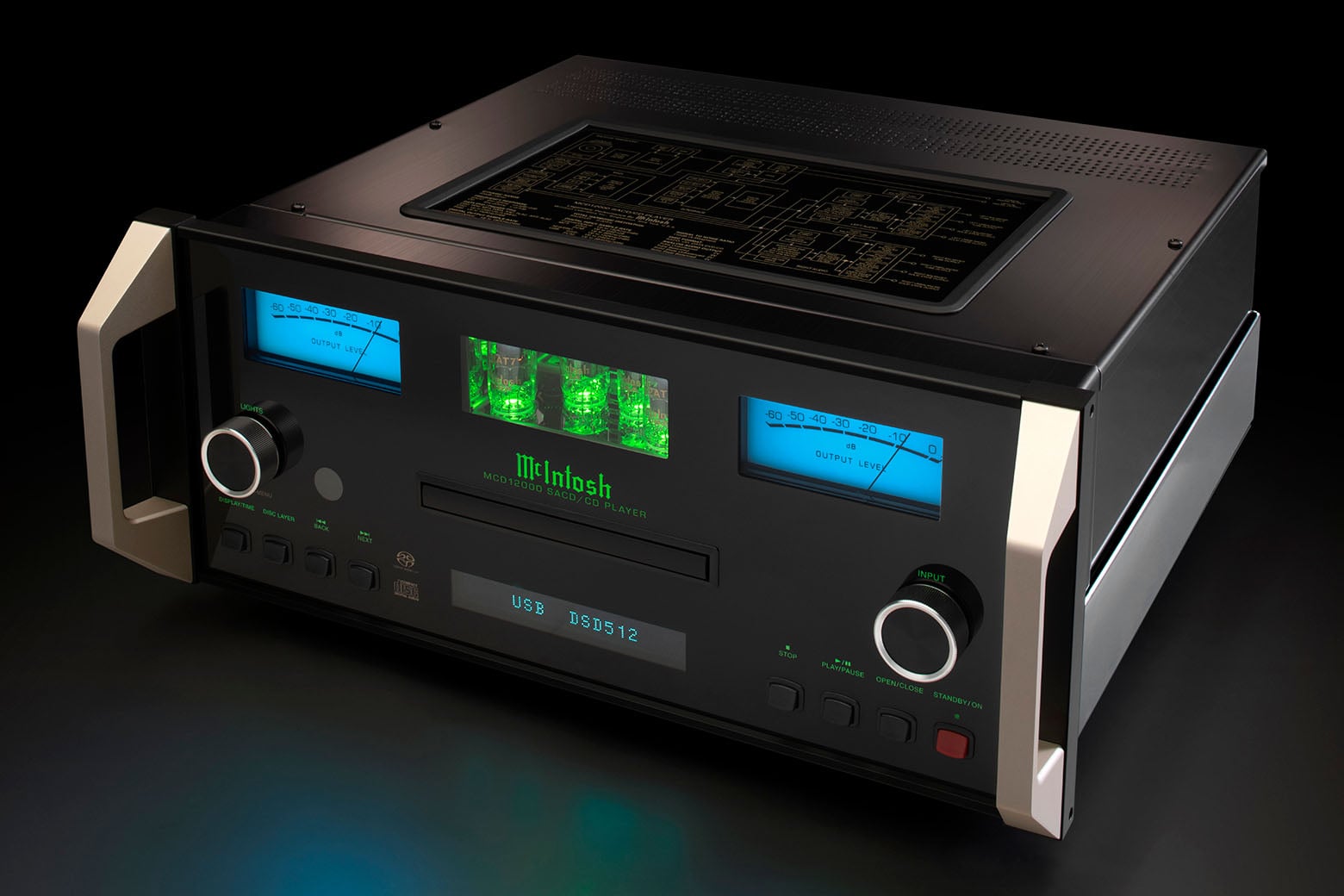
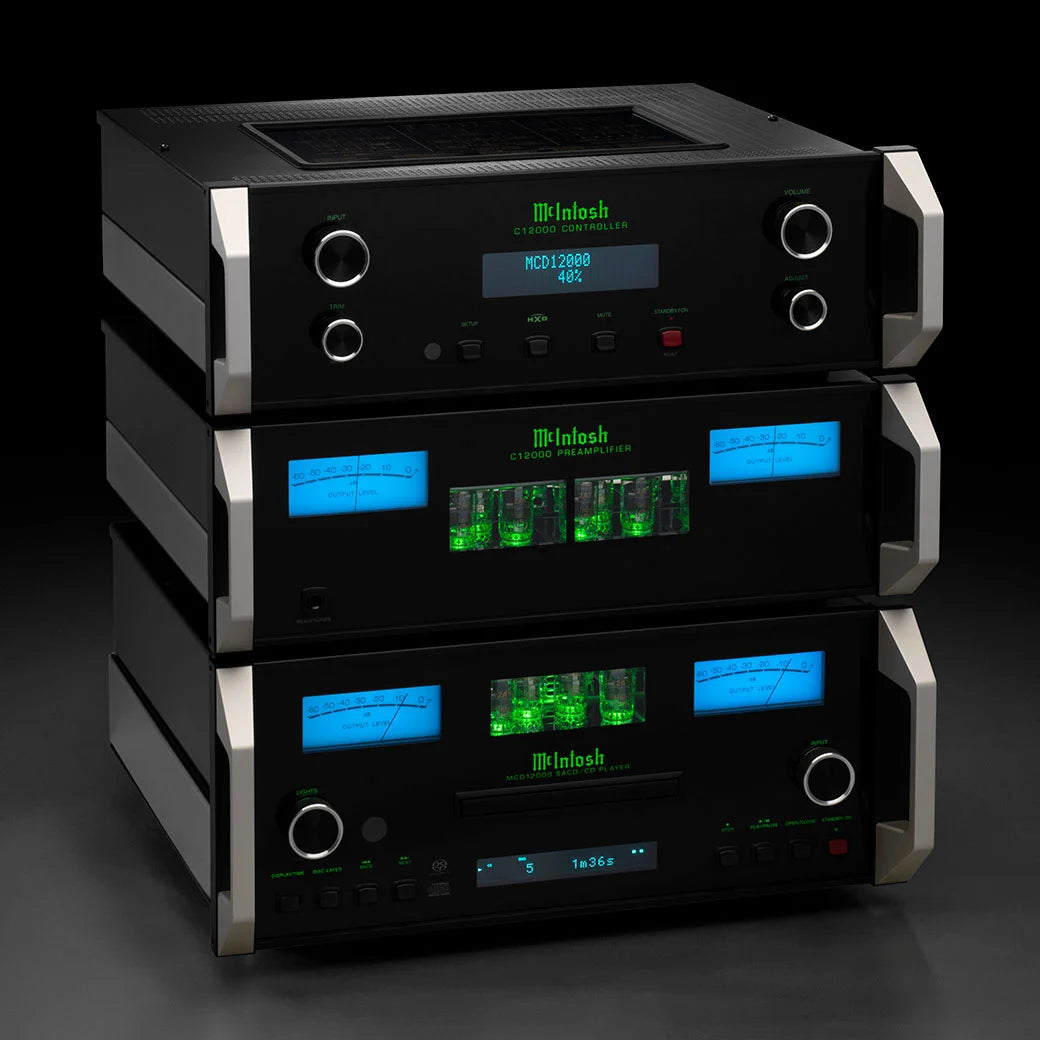

McIntosh MCD12000 2-Channel SACD/CD Player
- A reference level DAC that includes a reference level CD Player
- Includes our Hybrid Drive™ technology that uses the best of vacuum tubes and solid state to produce the best sound performance
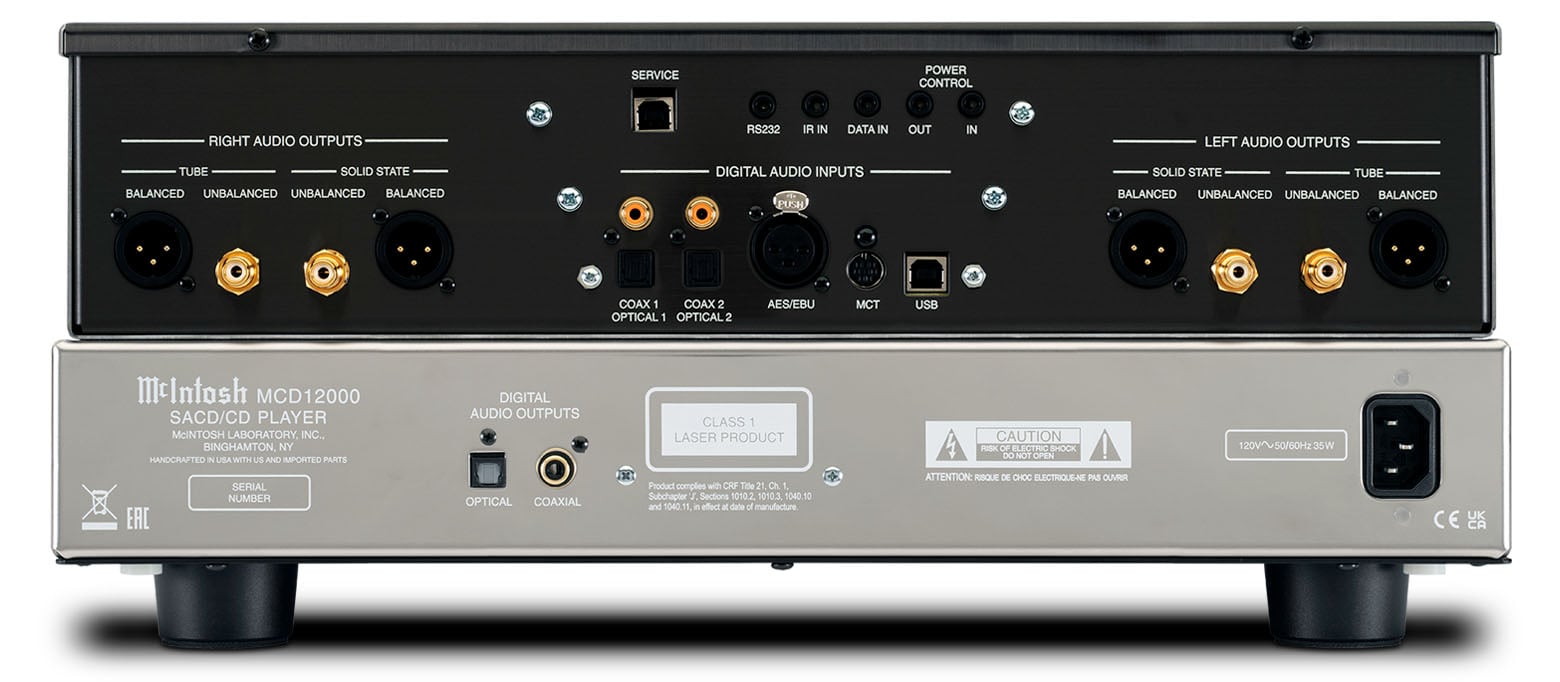
- Balanced and unbalanced analog outputs in both solid state and vacuum tube configurations
- (2) 32-bit/8-channel professional grade DACs
- 7 digital inputs
Pairs well with
McIntosh MCD12000 2-Channel SACD/CD Player
If you have any questions, you are always welcome to contact us. We'll get back to you as soon as possible, within 24 hours on weekdays.
-
Shipping Information
Use this text to answer questions in as much detail as possible for your customers.
-
Customer Support
Use this text to answer questions in as much detail as possible for your customers.
-
FAQ’s
Use this text to answer questions in as much detail as possible for your customers.
-
Contact Us
Use this text to answer questions in as much detail as possible for your customers.
Overview
McIntosh MCD12000 SACD/CD Player & Reference DAC
Two Reference Components in One
Calling the McIntosh MCD12000 simply an SACD/CD player doesn't really describe what it is.
At its core, the MCD12000 is a reference-level Digital-to-Analog Converter built to handle virtually every digital source in a serious audio system. McIntosh then adds a reference-level SACD/CD transport to create one formidable digital front end.
Whether the music comes from an SACD, CD, computer, music server, streamer or external digital transport, it passes through the MCD12000's sophisticated dual-DAC architecture and your choice of vacuum tube or solid-state analog output stages.
Designed as a natural partner for the McIntosh C12000 Preamplifier, the MCD12000 represents McIntosh's no-compromise approach to digital playback.
Dual ESS SABRE PRO DACs
The digital architecture begins with two ESS SABRE PRO ES9038PRO 32-bit/8-channel DACs.
Rather than sharing one DAC between stereo channels, the MCD12000 dedicates an entire ES9038PRO to the left channel and another to the right.
Each operates in Octal-Balanced Mono mode, utilizing all eight DAC outputs for its assigned audio channel.
The ES9038PRO incorporates ESS's HyperStream II architecture and Time Domain Jitter Eliminator, technologies developed for demanding audiophile and professional digital applications.
It's an appropriately extreme DAC implementation for McIntosh's reference digital source.
Separate Digital and Analog Power Supplies
McIntosh goes beyond the DAC chips themselves.
The MCD12000 uses separate power supplies for its digital and analog circuitry, helping isolate the sensitive analog audio stages from noise generated by digital electronics.
A specially constructed R-Core power transformer further minimizes noise radiation.
It's the kind of internal engineering that isn't obvious from the front panel but becomes increasingly important when you're building a source component at this level.
Tube or Solid State? You Choose.
One of the MCD12000's defining features is McIntosh Hybrid Drive™ technology.
Instead of forcing you to choose between a vacuum tube or solid-state source component, the MCD12000 gives you both.
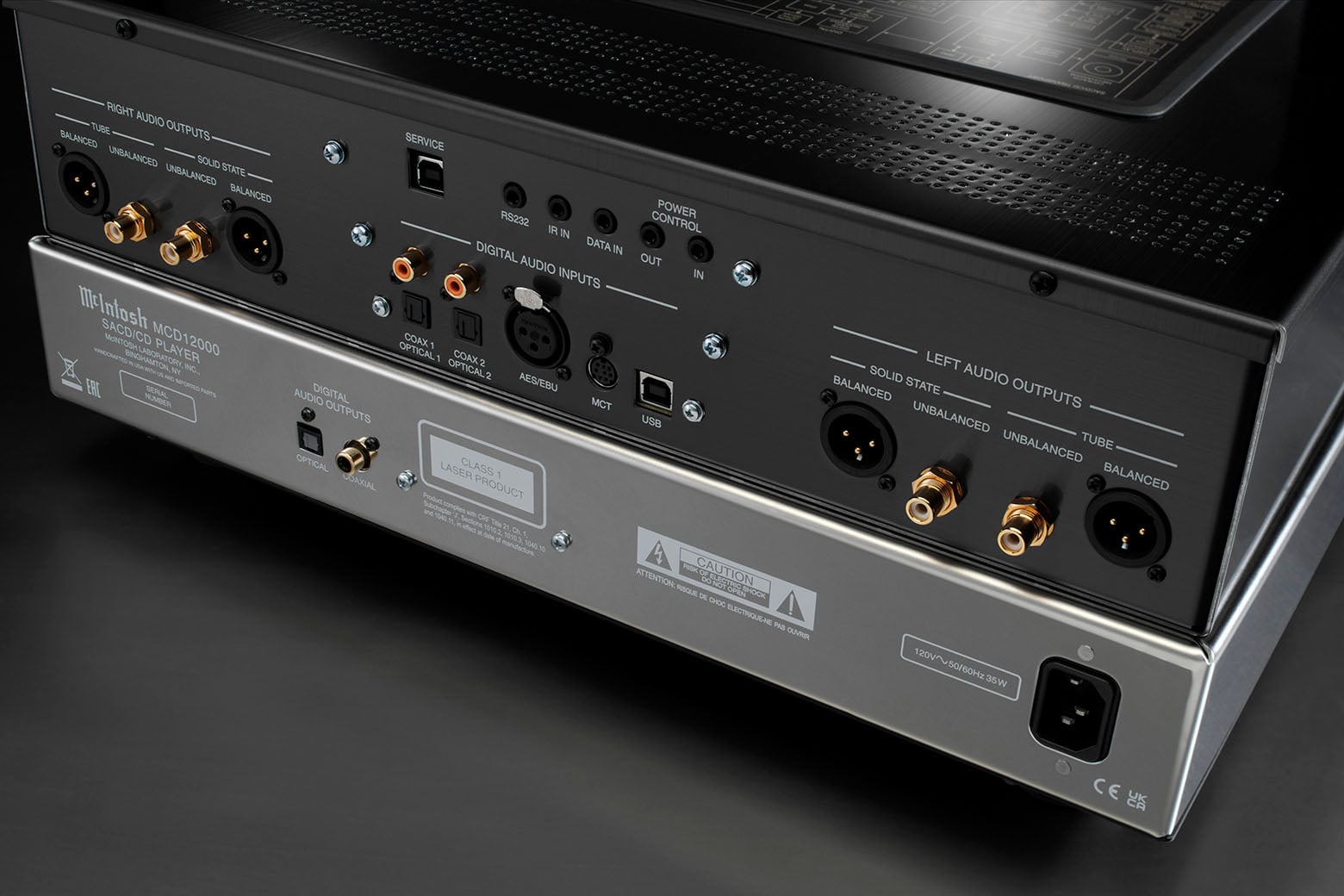
Separate fixed analog outputs are provided for the vacuum tube and solid-state output stages, in both balanced and unbalanced configurations.
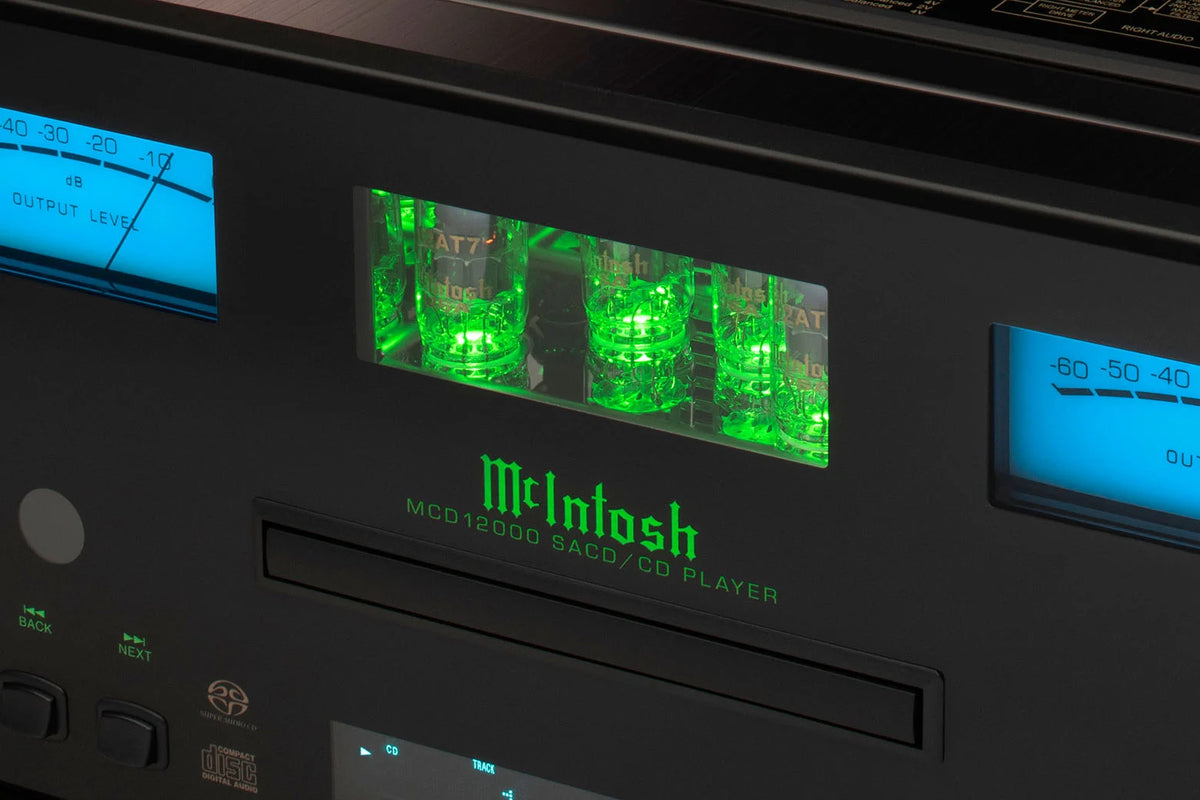
For tube output, each channel receives its own 12AT7 and 12AX7A vacuum tubes. The solid-state output uses a discrete balanced op-amp.
The result is an unusual amount of flexibility. You can choose the output stage that best complements the recording, the rest of the system or simply your personal preference.
Seven Digital Inputs
The MCD12000 is designed to become the conversion center for an entire digital system.
Its seven digital inputs include two coaxial, two optical, USB Type B, AES/EBU and McIntosh MCT.
USB supports high-resolution playback up to 32-bit/384kHz PCM, DSD512 and DXD 384kHz, making the MCD12000 a serious DAC for computer-based audio and compatible digital music sources.
The MCT input also allows an existing McIntosh MCT-series transport to access the MCD12000's reference DAC architecture.
So even when there's no disc in the tray, the MCD12000 can remain the primary digital source component in the system.
Reference SACD and CD Playback
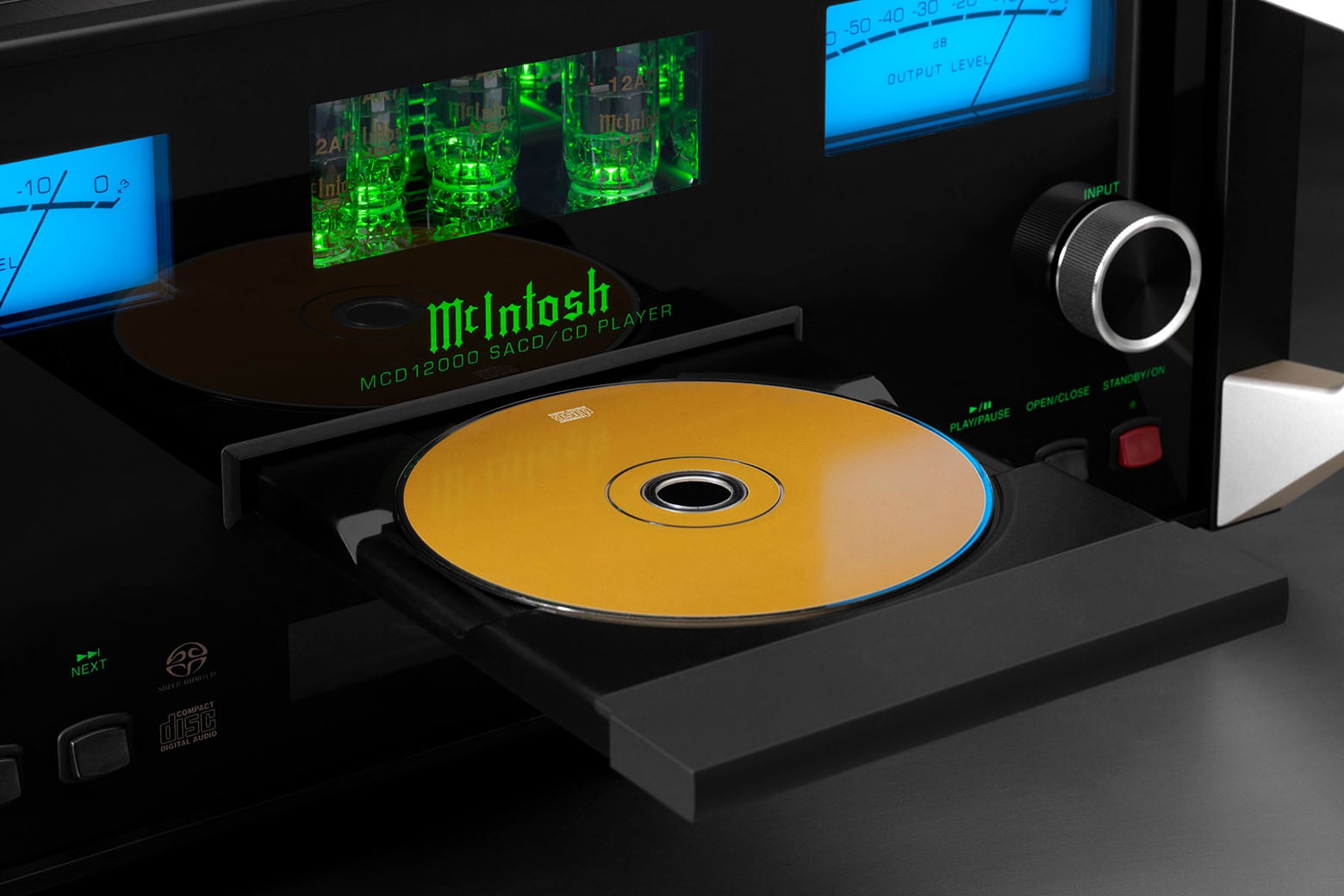
Of course, the MCD12000 is also a formidable physical-media player.
A twin-laser optical pickup is designed to accurately read the different disc formats, while a precision die-cast aluminum tray provides smooth and quiet disc handling.
Audio data is read at twice normal speed, allowing additional processing for tracking and error correction before playback.
Beyond commercial SACDs and CDs, the MCD12000 can also play compatible music files stored on user-generated CD and DVD data discs, including high-resolution formats such as FLAC, WAV and DSD.
Your physical music library isn't an afterthought here. It's one of the reasons the MCD12000 exists.
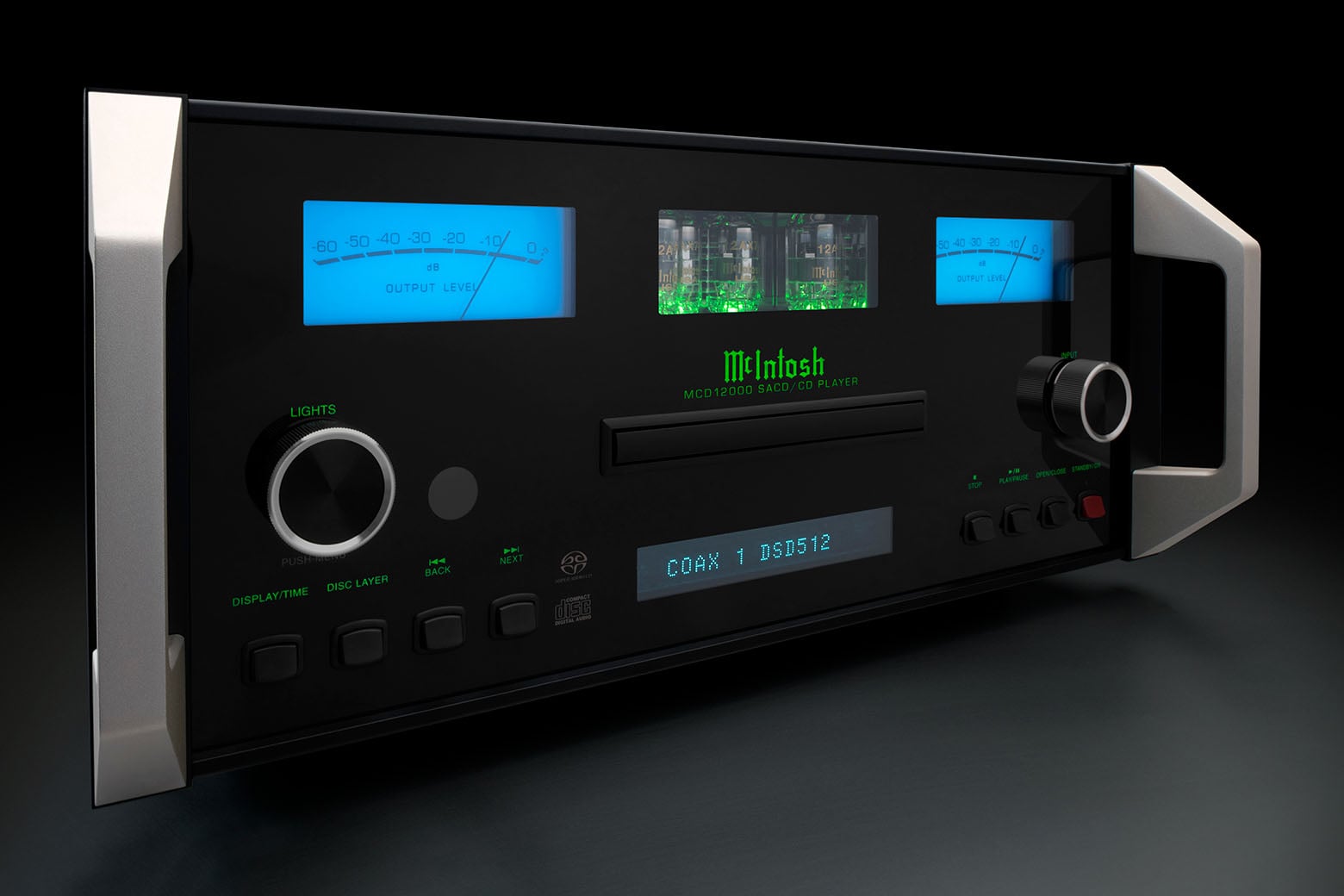
McIntosh Meters Meet Digital Audio
A pair of classic 60dB McIntosh output meters displays the signal level being delivered from the left and right analog outputs.
Volume itself is controlled by the connected preamplifier, integrated amplifier or other control component, but the meters respond dynamically to the music being played.
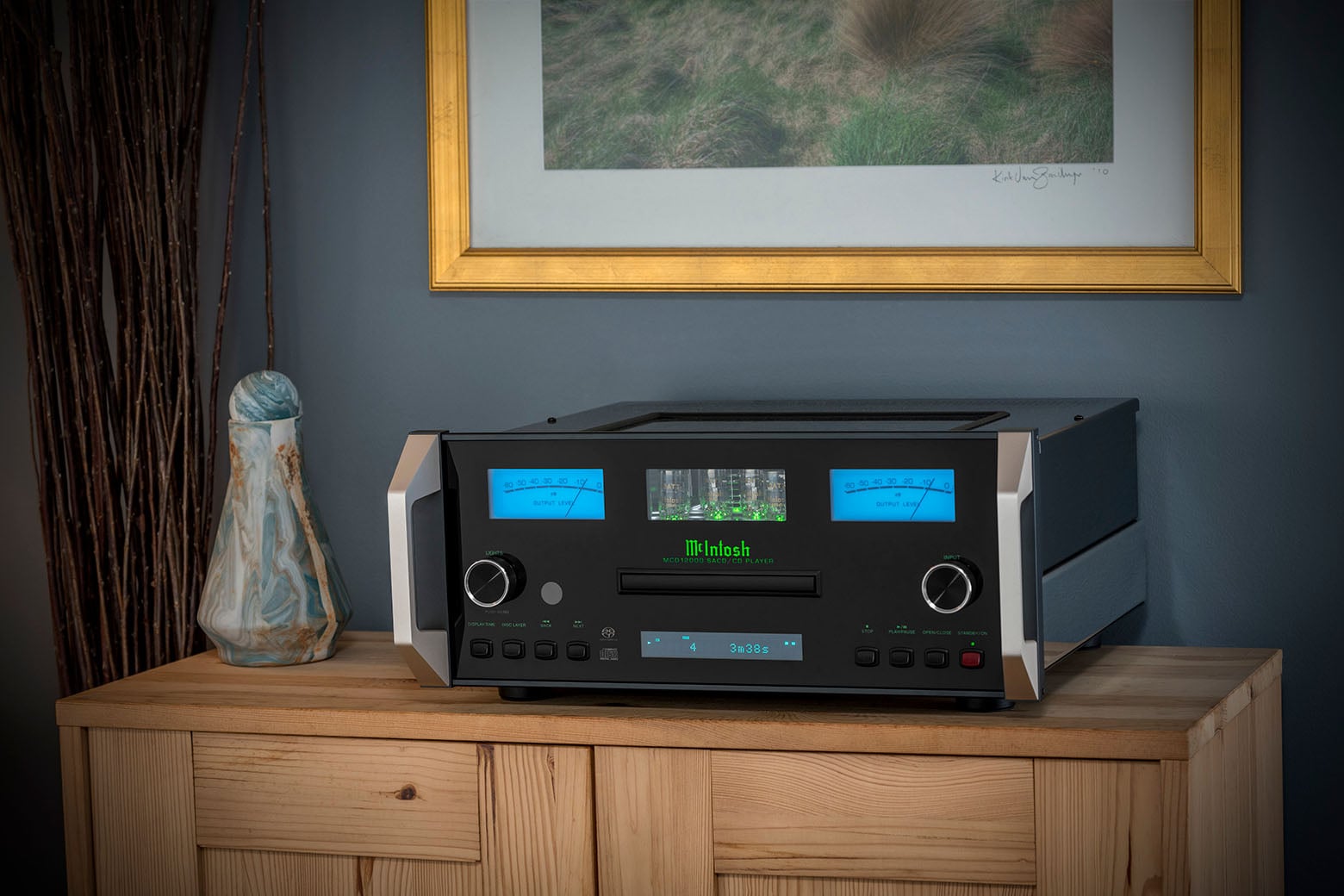
It's a distinctly McIntosh touch—and one that gives the MCD12000 considerably more visual presence than the typical high-end DAC or disc player.
Designed for the C12000
The connection between the MCD12000 and C12000 Preamplifier isn't limited to performance.
The MCD12000's lower chassis uses mirror-polished stainless steel, while the upper section is finished in hairline-brushed black Titanium stainless steel to complement the C12000.
The signature black-glass front panel is joined by an illuminated McIntosh logo, rotary controls, push buttons and custom-machined brushed-aluminum handles.
A glass panel on top displays performance information and a block diagram of the audio signal path.
Together, the MCD12000 and C12000 create a digital and analog front end with unmistakable McIntosh presence.
The Grid's Take on the McIntosh MCD12000
The MCD12000 is the McIntosh digital source for someone who doesn't want to choose between a great DAC and a great disc player.
You get both.
But what really separates it from the rest of the McIntosh disc-player lineup is the architecture behind it: two dedicated ES9038PRO DACs, Octal-Balanced Mono conversion, separate analog and digital power supplies, DSD512 capability, seven digital inputs and independent tube and solid-state analog output stages.
The tube/solid-state choice is particularly compelling. It isn't a digital filter or simulated sonic profile—you're choosing between two actual analog output architectures.
And while SACD/CD playback is a major part of the MCD12000, you don't stop using the component when you start streaming. Connect a high-end streamer or server to one of its digital inputs and the MCD12000 becomes the DAC for that source as well.
For a reference McIntosh system—particularly one built around the C12000—this is the digital front end we would look at first.
At The Grid HiFi & Home Theater, we can help configure the MCD12000 as part of a complete McIntosh reference system, including source integration, preamplification, amplification and loudspeaker matching.
Specifications
Audio Specifications
Number of Channels
2
Fixed Output Level
2.0Vrms Unbalanced
4.0Vrms Balanced
Variable Output Level
N/A
Output Impedance
600 ohms Unbalanced and Balanced
Frequency Response
4Hz to 40kHz, +0.5, -2dB (SACD)
4Hz to 20kHz, ±0.5dB (CD)
Signal To Noise Ratio
110dB (A-weighted)
Dynamic Range
Better than 100dB
Total Harmonic Distortion
0.003% @ 1000Hz
Channel Separation
Better than 98dB (1,000Hz)
Headphone Output Impedance
N/A
Digital Audio Specifications
Digital-to-Analog Converter (DAC) Type
Professional Grade 8-channel, 32-bit PCM/DSD, Quad Balanced, 1 DAC per channel (2 DACs total)
Coaxial Sample Rate
16, 24-bit/192kHz
Optical Sample Rate
16, 24-bit/192kHz
USB Sample Rate
16, 24, 32-bit/384kHz
DXD: DXD352.8kHz, DXD384kHz
DSD: DSD64, DSD128, DSD256, DSD512
Digital Coaxial Input
0.5V p-p/75 ohms
Digital Optical Input
-15dbm to -21dbm
Digital Output Sample Rate
Up to 24-bit/192kHz
Digital Optical Output
-15dbm to -21dbm
Digital Coaxial Output
0.5V p-p/75 ohms
Digital Output Jitter
N/A
Digital XLR Output
N/A
Digital MCT Output
N/A
Connectivity
Balanced Fixed Output
2 (1 for Solid State, 1 for Vacuum Tube)
Unbalanced Fixed Output
2 (1 for Solid State, 1 for Vacuum Tube)
Balanced Variable Output
0
Unbalanced Variable Output
0
Digital Coaxial Inputs
2
Digital MCT Inputs
1
Digital Optical Inputs
2
Digital USB Input
1 (rear)
Digital USB Input Type
Type B
Digital Coaxial Outputs
1
Digital MCT Output
0
Digital Optical Outputs
1
Digital XLR Output
0
Headphone Output
0
Control
Power Control Inputs
1
Power Control Outputs
1
Rear Panel Data Inputs
1
Rear Panel IR Sensor Inputs
1
RS232 Control Inputs
1
General Specifications
Disc Formats
SACD, CD, CD-R/RW and DVD-R; popular file formats such as AAC, AIFF, ALAC, DSD (up to DSD128), FLAC, MP3, WAV (up to 24-bit/192kHz) and WMA
Disc Capacity
1
Laser Type
Twin Beam
Laser Beam Wavelength
650nm (SACD)
790nm (CD)
Laser Power
CLASS IIa/CLASS I
Standby Power Requirement
<0.5 watt
Weights & Dimensions
Unit Dimensions (W x H x D)
17-1/2" (44.45cm) x 7-5/8" (19.4cm) x 19" (48.3cm) Note: When the Disc Tray is opened, the panel clearance required in front of mounting panel is 6-3/4" (17.2cm).
Unit Weight
32.5 lbs (14.7 kg)
Shipping Weight
48 lbs (21.8 kg)
FAQs
Please read our FAQs page to find out more.
Do you price match?
Yes. We match any authorised dealer, including big-box retailers. If you find the same product at a lower price, contact us and we'll match it.
Do you offer free shipping?
Yes — free shipping on every order, with 2-day delivery available on most products. Easy returns and exchanges are included.
Where is your showroom?
We're at 6362 Alder Drive, Houston, Texas. The showroom lets you hear and compare reference-level systems in person before making any decisions. If you're considering a larger purchase or installation, it's well worth the visit.
Can I buy online without visiting the showroom?
Yes. The full product range is available through the online store with free nationwide shipping. For more complex system builds, speaking with one of our advisers first tends to lead to a better result.
Do you offer financing?
Yes. Special financing is available through the BrandSource Credit Card for qualifying purchases, allowing you to spread payments over time with no annual fee. Promotional rebate savings are also available periodically. See the financing page for full details.
Do you install systems as well as sell equipment?
Yes — installation is central to what we do. We design and install whole-home audio and video, home theaters, media rooms, outdoor audio, lighting and motorised shades, and full smart home automation.
Do you provide support after installation?
Yes. We provide ongoing service and support to ensure systems continue performing as intended — not just on installation day, but over the long term.