Goldmund Mimesis Excellence Digital / Analogue Preamplifier
The Goldmund Mimesis Excellence is a reference digital and analogue stereo preamplifier built around Goldmund's Themis audio architecture, dedicated left- and right-channel audio boards, independently powered analogue and digital circuitry, a custom high-resolution DAC capable of PCM up to 768kHz and DSD512, and an external power-supply chassis. Designed as the control center for a no-compromise two-channel system, it combines five analogue inputs, five digital inputs, balanced and unbalanced outputs, precision volume control and extraordinarily low published distortion. Goldmund
Goldmund specifies a signal-to-noise ratio exceeding 130dB, channel separation greater than 85dB, balanced THD of just 0.0004%, and bandwidth extending to 530kHz at -3dB. The Mimesis Excellence is engineered not simply to accommodate both analogue and digital sources, but to preserve extremely small signal information while providing the drive, output level and control required by reference power amplifiers. Goldmund
Goldmund Themis Audio Architecture
At the heart of the Mimesis Excellence is Goldmund's Themis audio board, developed specifically for its latest generation of preamplification.
Rather than processing both stereo channels through a shared audio board, the left and right channels each receive a dedicated audio card. Each channel has its own DAC and volume-control architecture, reducing interaction between channels and allowing the signal paths to operate independently. Goldmund
This dual-channel separation is fundamental to the Excellence design. Goldmund reports greater than 85dB channel separation from 20Hz to 20kHz, while the line-input signal-to-noise ratio exceeds 130dB. Goldmund
Custom High-Resolution DAC
Unlike Goldmund's analogue-only Mimesis Reference, the Mimesis Excellence incorporates a newly developed custom DAC architecture.
Goldmund specifically notes that the DAC is a new design not found in the preamplifier's predecessor, engineered for extremely low noise and distortion. The digital architecture also incorporates a customized clock-generation system designed to minimize jitter. Goldmund
The current specification supports:
PCM up to 768kHz
DSD up to DSD512 Goldmund
This gives the Mimesis Excellence the ability to function as both the reference preamplifier and high-resolution digital conversion stage of a system, potentially eliminating the need for a separate DAC.
Dedicated Left & Right Channel Processing
The architecture extends beyond simply separating the physical audio boards.
Each channel has its own DAC, analogue circuitry and precision volume-control system, allowing left and right signals to remain separated through critical stages of the preamplifier. Goldmund's design objective is to minimize crosstalk and prevent electrical activity in one channel from contaminating the other. Goldmund
For a reference preamplifier, this separation is particularly important to stereo imaging, low-level information and spatial resolution.
Precision Volume Control
The Themis platform incorporates a newly developed high-precision volume controller.
Goldmund engineered the system to maintain signal quality across a very wide range of listening levels rather than optimizing performance only near maximum output. Each channel has its own volume-control architecture, while front-panel and remote controls provide volume and balance adjustment. Goldmund
The Mimesis Excellence also includes Volume Memo, allowing a preferred volume level to be stored and recalled. Goldmund
Five Analogue Inputs
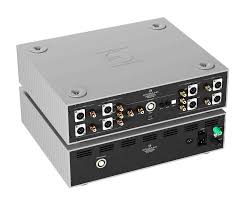
For reference analogue systems, the Mimesis Excellence provides:
3 × stereo RCA analogue inputs
2 × stereo XLR balanced analogue inputs
Input impedance is 51kΩ. Maximum input level is 10.3Vrms unbalanced and 19.2Vrms balanced. Goldmund
That provides enough analogue connectivity for sophisticated systems incorporating a phono stage, reel-to-reel deck, DAC, streamer or other line-level sources without requiring an external input switcher.
For vinyl playback, a dedicated phono preamplifier such as Goldmund's Mimesis PH3.8 Nextgen would remain necessary because the Excellence's analogue inputs are line-level.
Five Digital Inputs
The digital side is equally comprehensive.
The Mimesis Excellence provides:
2 × S/PDIF coaxial RCA inputs
2 × optical digital inputs
1 × USB Audio input
Combined with its five analogue connections, the preamplifier offers 10 source inputs in total. Goldmund's operating manual confirms that its input selector cycles through five analogue and five digital sources. Goldmund
USB Audio provides the highest-resolution direct digital connection, supporting PCM up to 768kHz and DSD512. Goldmund
Balanced & Unbalanced Outputs
The Excellence provides extensive output connectivity:
2 × stereo RCA analogue outputs
2 × stereo XLR balanced analogue outputs
Output impedance is only 75Ω, supporting effective interfacing with external power amplifiers and longer interconnect runs.
Maximum output is specified at an unusually substantial:
10Vrms unbalanced
20Vrms balanced. Goldmund
Those figures provide considerable output headroom when driving compatible reference amplification.
Ultra-Low Distortion
Goldmund publishes exceptionally low distortion figures for the Mimesis Excellence.
At a 1Vrms output level with an 80kHz measurement bandwidth and 600Ω termination:
| Signal Path |
Published THD |
| Unbalanced analogue in → unbalanced out |
0.0006% |
| Balanced analogue in → balanced out |
0.0004% |
| Unbalanced digital in → unbalanced out |
0.00085% at -6dBFS |
These numbers are particularly relevant in a preamplifier, where the objective is not to generate power but to preserve the information already present in the source signal before passing it to the power amplifier.
Greater Than 130dB Signal-to-Noise Ratio
Goldmund specifies the line-input signal-to-noise ratio at greater than 130dB, measured from 0.01Hz to 10MHz.
A-weighted performance is specified at greater than 140dB. Goldmund
This extremely low-noise architecture works alongside the physically separated power supply, independent channel boards and shielding strategy to reduce electrical and electromagnetic contamination of the audio signal.
0.2Hz–530kHz Extended Bandwidth
The Mimesis Excellence is engineered with extraordinarily wide bandwidth.
Goldmund specifies:
20Hz–20kHz: ±0dB
0.2Hz–530kHz: ±3dB. Goldmund
The amplification stages have a specified 15V/µs slew rate. Goldmund
The importance of this bandwidth isn't reproduction of ultrasonic music content. It reflects Goldmund's emphasis on transient behavior, phase integrity and avoiding premature bandwidth limitations within the signal path.
Blocked Mechanical Shielding
Themis incorporates a specialized blocked mechanical shielding system intended to protect the audio circuitry from electromagnetic emissions that could contaminate the signal.
Goldmund combines this shielding with a modular architecture in which the Themis boards operate independently from other component sections. The modular construction also simplifies servicing and maintenance while maintaining isolation between critical circuits. Goldmund
Fully Separated Power Architecture
Power-supply design is unusually extensive for a preamplifier.
Goldmund uses fully separated left- and right-channel digital and analogue power supplies, incorporating customized high-end transformers and two stages of power regulation. Goldmund
A dedicated power-management system supervises operation.
This approach minimizes interaction between the digital circuitry, analogue stages and individual stereo channels rather than feeding every section from a common supply.
Separate External Power Supply
Goldmund takes isolation one step further by physically separating the power supply from the audio chassis.
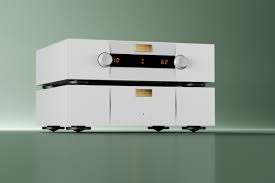
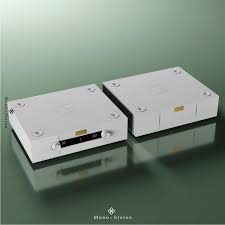
The Mimesis Excellence therefore consists of two full-width components:
Mimesis Excellence Preamplifier
Mimesis Excellence Power Supply
Goldmund states that the separate supply is intended to minimize transformer-generated vibration reaching the audio circuitry. The two chassis are connected by a dedicated power cable, and Goldmund recommends separating the units as much as that connection permits. Goldmund
The preamplifier and power supply are even shipped in two separate custom flight cases. Goldmund
Goldmund Mechanical Grounding
The Mimesis Excellence also incorporates Goldmund's Mechanical Grounding philosophy.
Introduced by Goldmund in 1982, Mechanical Grounding is intended to provide unwanted mechanical energy with a controlled path out of the component rather than allowing vibration to accumulate within its structure. Goldmund
Goldmund specifically recommends installing the Excellence on a very rigid support directly coupled to the ground rather than using soft decoupling materials. Goldmund
Separate Ground & Earth Signal
Electrical grounding receives similar attention.
Goldmund specifies separated ground and earth signal paths, while the external power-supply chassis provides a dedicated earthing post. Goldmund
This is another part of the larger design strategy: electrical noise, electromagnetic interference, mechanical vibration and power-supply contamination are addressed independently rather than relying on one isolation technique.
Front-Panel & Remote Operation
Despite the engineering complexity inside, daily operation remains straightforward.
Front-panel controls provide:
Volume
Balance
Mute
Standby
Volume Memory
The supplied remote provides corresponding control, while a USB-C control port allows computer-based communication with the preamplifier. Goldmund
A locking indicator confirms when a valid digital audio signal is detected.
Goldmund Industrial Design
The Mimesis Excellence follows Goldmund's current design language with its screw-free top-panel appearance and distinctive wave-pattern side panels.
Two primary finishes are listed:
Grey
Black. Goldmund
Goldmund notes that international-market models use a matching grey top-panel accent ring, while Chinese-market units receive a gold accent ring. Finish availability and lead times can vary. Goldmund
Goldmund Mimesis Excellence Technical Specifications
| Specification |
Goldmund Mimesis Excellence |
| Product Type |
Digital / Analogue Stereo Preamplifier |
| Audio Architecture |
Goldmund Themis |
| Channel Architecture |
Dedicated Left & Right Audio Boards |
| DAC |
Custom Goldmund DAC Architecture |
| Maximum PCM |
Up to 768kHz |
| Maximum DSD |
DSD512 |
| Analogue Inputs |
3 × stereo RCA + 2 × stereo XLR |
| Digital Inputs |
2 × RCA S/PDIF + 2 × Optical + USB Audio |
| Total Source Inputs |
10 |
| Input Impedance |
51kΩ |
| Maximum Balanced Input |
19.2Vrms |
| Maximum Unbalanced Input |
10.3Vrms |
| RCA Outputs |
2 × stereo pairs |
| XLR Outputs |
2 × stereo pairs |
| Output Impedance |
75Ω |
| Maximum Balanced Output |
20Vrms |
| Maximum Unbalanced Output |
10Vrms |
| Frequency Response |
20Hz–20kHz ±0dB |
| Extended Frequency Response |
0.2Hz–530kHz ±3dB |
| Balanced THD |
0.0004% |
| Unbalanced THD |
0.0006% |
| Digital-to-Unbalanced THD |
0.00085% at -6dBFS |
| Signal-to-Noise Ratio |
>130dB |
| A-Weighted SNR |
>140dB |
| Channel Separation |
>85dB, 20Hz–20kHz |
| Slew Rate |
15V/µs |
| Power Supply |
Separate External Chassis |
| Power Regulation |
Two-Stage |
| Grounding |
Separated Ground / Earth Signal |
| Maximum Power Consumption |
20W |
| Nominal Voltage |
115V / 230V |
| Voltage Range |
±15% |
| Preamplifier Dimensions |
17.3 W × 5.16 H × 15.8 D in. |
| Preamplifier Metric Dimensions |
44 W × 13.1 H × 40 D cm |
| Preamplifier Weight |
11.5 kg / 25.4 lb |
| Power Supply Dimensions |
17.3 W × 5.16 H × 15.2 D in. |
| Power Supply Metric Dimensions |
44 W × 13.1 H × 38.6 D cm |
| Power Supply Weight |
13 kg / 28.7 lb |
| Combined Component Weight |
24.5 kg / approx. 54 lb |
| Finishes |
Grey / Black |
| Shipping |
Two Custom Flight Cases |
The dimensional figures above come from Goldmund's Rev. C specification sheet, which is newer than the Rev. B manual and contains slightly revised chassis dimensions. I would therefore use the Rev. C measurements for The Grid's Shopify listing. Goldmund
Mimesis Excellence vs. Mimesis Signature
This distinction is worth establishing because both models are current Goldmund digital/analogue preamplifiers.
The Mimesis Signature uses an ESS9028Q2M SABRE32 DAC and is a single-chassis design. The Mimesis Excellence moves higher in the range with the Themis platform, dedicated audio cards for each channel, individual DAC and volume architecture, more elaborate channel separation and a physically separate power-supply chassis. Goldmund
Above the Excellence sits the Mimesis Reference, but that product takes a different approach: it is an analogue-only reference preamplifier, whereas the Excellence is designed to accommodate both reference analogue and high-resolution digital sources. Goldmund
That gives the Excellence a very specific position in Goldmund's range: it is the company's upper-tier solution for a reference system requiring both digital and analogue preamplification.
Goldmund Mimesis Excellence at The Grid HiFi
The Goldmund Mimesis Excellence is designed for systems where the preamplifier cannot become the limiting component. Its Themis architecture, dedicated left- and right-channel processing, custom high-resolution DAC, separate power-supply chassis, >130dB signal-to-noise ratio and 0.0004% balanced THD make it an appropriate control center for the highest levels of passive two-channel audio.
The Grid HiFi can build the complete system around the Mimesis Excellence, including Goldmund Telos power amplification, reference loudspeakers, streaming and digital sources, turntables and phono stages, cabling, power and equipment support, with component matching based on the loudspeaker, room and listening priorities.
Considering the Goldmund Mimesis Excellence? Call The Grid HiFi at (713) 218-8120 to arrange a private audition and build a complete Goldmund reference system around it.