



Berkeley Audio Design Alpha USB Series 2 | The Grid HiFi
Pairs well with
Berkeley Audio Design Alpha USB Series 2 | The Grid HiFi
If you have any questions, you are always welcome to contact us. We'll get back to you as soon as possible, within 24 hours on weekdays.
-
Shipping Information
Use this text to answer questions in as much detail as possible for your customers.
-
Customer Support
Use this text to answer questions in as much detail as possible for your customers.
-
FAQ’s
Use this text to answer questions in as much detail as possible for your customers.
-
Contact Us
Use this text to answer questions in as much detail as possible for your customers.
Overview
Berkeley Audio Design Alpha USB Series 2 USB Digital Audio Interface
The Berkeley Audio Design Alpha USB Series 2 is a high-performance USB-to-AES/EBU and USB-to-S/PDIF digital audio interface designed to isolate electrical noise from a music server or computer, reclock the digital audio signal and deliver it to an external DAC through a precision 110Ω AES/EBU XLR or 75Ω BNC S/PDIF connection. Berkeley Audio Design
Rather than operating as a simple USB converter, the Alpha USB Series 2 addresses three critical areas of digital playback: USB processing, electrical isolation and clock accuracy. It supports asynchronous USB Audio 2.0, PCM up to 24-bit/192kHz, individually tested low-phase-noise output master clocks and a dedicated isolated linear power supply for its digital output circuitry. Berkeley Audio Design
Asynchronous USB 2.0 High Speed Audio
The Alpha USB Series 2 uses a USB Type-B asynchronous USB Audio 2.0 input with Berkeley's proprietary high-speed, low-latency input software.
It is specifically optimized for modern streamer/server platforms with USB 2.0 High Speed Audio output rather than relying on a generic USB receiver implementation. Supported resolution extends from 44.1kHz through 192kHz at up to 24-bit. Berkeley Audio Design
Extensive Electrical Isolation
A major purpose of the Alpha USB Series 2 is preventing electrical noise generated by the source from reaching the DAC.
The USB receiver and processing circuitry are powered from the USB source, while the AES/EBU and S/PDIF master clocks and line drivers receive power from a separate isolated linear power supply. Berkeley specifies no DC connection between the USB input and digital output circuitry, along with a high degree of capacitive and inductive isolation. Berkeley Audio Design
This separation allows the USB-connected server and the precision digital-output stage to operate in electrically distinct environments.
Low-Phase-Noise Master Clocks
After receiving the USB audio stream, the Alpha USB Series 2 generates its AES/EBU or S/PDIF output using very-low-phase-noise, low-jitter audio master clocks.
Berkeley individually tests these clocks and identifies them as one of the three core technologies behind the interface, alongside its proprietary USB software and electrical isolation architecture. Berkeley Audio Design
The objective is to present the connected DAC with a clean, accurately timed digital signal rather than simply translating USB packets into another connector format.
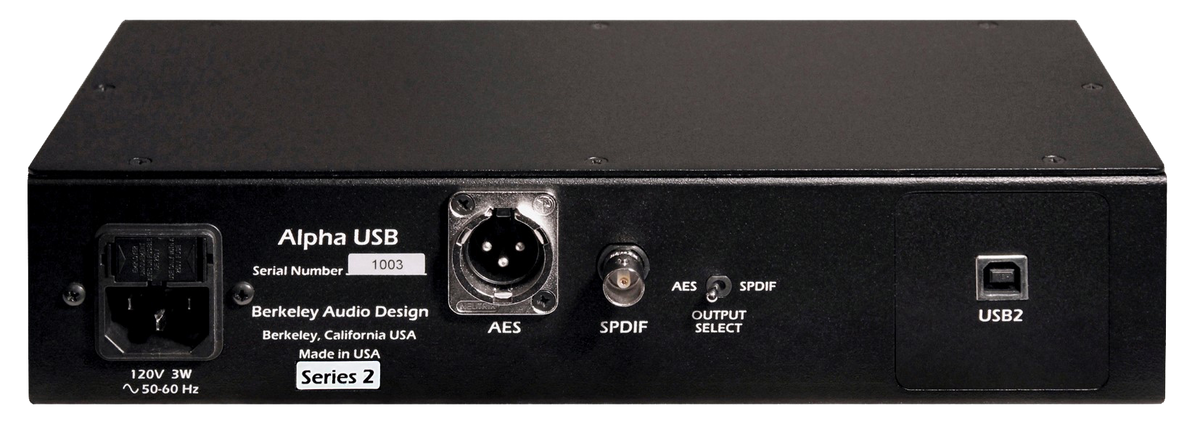
110Ω AES/EBU & True 75Ω BNC S/PDIF
A front-panel switch selects between two digital outputs:
AES/EBU — 110Ω balanced XLR
S/PDIF — 75Ω coaxial BNC
Both support PCM up to 24-bit/192kHz. Berkeley Audio Design
The ability to choose either interface is particularly useful with reference DACs such as the Berkeley Alpha DAC Series 3 and Series 3P, which provide both AES/EBU and true 75Ω BNC inputs.
Purpose-Built for Music Servers
The Alpha USB Series 2 is designed to work with Linux-based music servers, Apple Mac and Windows PCs.
Berkeley specifies Linux compatibility with ALSA 1.0.23 or later and the ability to select the appropriate output device. Mac systems running Snow Leopard or later interface directly with the unit, as do Windows PCs running Windows 10 release 1703 or later. Berkeley Audio Design
For a dedicated high-end music server, the signal path becomes:
Music Server → USB → Alpha USB Series 2 → AES/EBU or BNC S/PDIF → DAC
This allows the server's USB output to be used while keeping the USB receiver and associated electrical environment outside the DAC chassis.
Ideal Partner for Berkeley Alpha DACs
Berkeley's DAC architecture intentionally avoids incorporating a conventional USB input. The Alpha USB Series 2 provides the bridge between a USB music server and Berkeley DACs equipped with AES/EBU and BNC S/PDIF inputs.
That makes it especially relevant with the Alpha DAC Series 3, which accepts 24-bit/192kHz PCM through AES/EBU, dual 75Ω BNC S/PDIF and Toslink. Berkeley Audio Design
The separate-interface approach allows Berkeley to optimize USB reception and isolation in one chassis while keeping the DAC focused on conversion, precision clocking and analog output.
Simple Front-Panel Operation
The Alpha USB Series 2 is intentionally straightforward to operate.
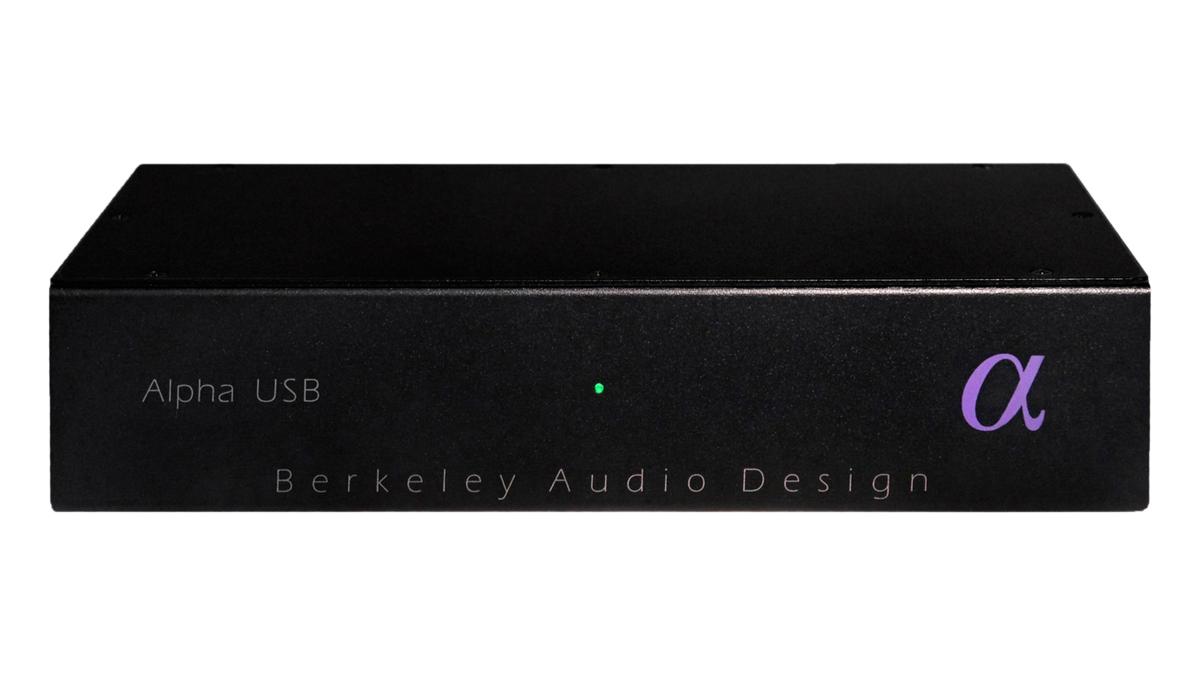
A front-panel Output Select switch chooses S/PDIF or AES output, while a status LED indicates operating condition:
Green — USB Lock
Amber — Standby Berkeley Audio Design
No additional signal processing, display system or unnecessary control circuitry is required.
Dedicated Linear Power Supply
The output master clocks and digital line drivers are powered by the Alpha USB Series 2's isolated linear power supply, independent of the USB-powered input circuitry.
The unit accepts 100V, 120V or 240V AC at 50/60Hz through a standard IEC inlet and consumes just 3 watts. Berkeley specifically states that the Alpha USB Series 2 is designed for continuous operation. Berkeley Audio Design
Berkeley Audio Design Alpha USB Series 2 Technical Specifications
| Specification | Alpha USB Series 2 |
|---|---|
| Product Type | USB Digital Audio Interface / Reclocking Noise Isolator |
| Primary Function | USB-to-AES/EBU or USB-to-S/PDIF Conversion |
| USB Standard | USB Audio 2.0 |
| USB Architecture | Asynchronous |
| USB Connector | Type-B |
| Maximum Word Length | 24-bit |
| Supported Sample Rates | 44.1kHz–192kHz |
| AES Output | 110Ω Balanced XLR |
| S/PDIF Output | 75Ω Coaxial BNC |
| Output Selection | Front-Panel Switch |
| Output Clocking | Individually Tested Low-Phase-Noise / Low-Jitter Master Clocks |
| DC Isolation | Yes |
| Capacitive Isolation | Yes |
| Inductive Isolation | Yes |
| USB Input Circuit Power | USB Source |
| Output Circuit Power | Separate Isolated Linear Supply |
| Status Indicator | Green USB Lock / Amber Standby |
| Operating Systems | Apple, Windows, Linux |
| Dimensions | 10.5"W × 5"D × 2.3"H |
| Height Including Feet | 2.55" |
| Weight | 2.5 lb |
| AC Mains | 100 / 120 / 240VAC, 50/60Hz |
| AC Connection | IEC |
| Power Consumption | 3W |
| Continuous Operation | Yes |
| Included Accessories | User Guide + 6' Power Cord |
Berkeley still provides the Alpha USB Series 2 Revision 2.0 User Guide through its current support/download section, and the product remains part of Berkeley's current product portfolio. Berkeley Audio Design
Alpha USB Series 2 vs. Alpha USB Reference Series
The Alpha USB Reference Series builds directly on the Series 2 architecture. Both provide asynchronous USB Audio 2.0, extensive input-to-output isolation, separate linear power for the digital output stage, selectable 110Ω AES/EBU and 75Ω BNC S/PDIF, and maximum resolution of 24-bit/192kHz. Berkeley Audio Design
The Reference Series advances the design with ultra-low-phase-noise reclocking technology derived from the Alpha DAC Reference Series 3P, along with increased enclosure mass and additional vibration isolation. The Reference chassis is 5.38 inches deep and weighs 2.8 pounds versus the Series 2 at 5 inches and 2.5 pounds. Berkeley Audio Design
The important distinction for the Shopify pages is that the Reference Series does not offer a higher PCM sampling rate. Both stop at 24-bit/192kHz. The Reference model's advancement is in clocking, time-domain accuracy, mechanical isolation and overall implementation.
Alpha USB Series 2 at The Grid HiFi
The Berkeley Audio Design Alpha USB Series 2 is an ideal solution for integrating a USB-equipped music server with a DAC optimized for AES/EBU or true 75Ω BNC S/PDIF. Its combination of asynchronous USB, extensive electrical isolation, precision output clocking and dedicated linear power makes it far more than a basic USB converter.
Pair it with the Berkeley Alpha DAC Series 3 or Series 3P, or use it to optimize the digital connection between a compatible music server and another high-performance DAC.
The Grid HiFi can configure the complete digital front end around the correct USB, AES/EBU or BNC connection, music server, DAC, amplification and system architecture.
Considering the Berkeley Alpha USB Series 2? Call The Grid HiFi at (713) 218-8120 to build the complete digital front end around it.
FAQs
Please read our FAQs page to find out more.
Do you price match?
Yes. We match any authorised dealer, including big-box retailers. If you find the same product at a lower price, contact us and we'll match it.
Do you offer free shipping?
Yes — free shipping on every order, with 2-day delivery available on most products. Easy returns and exchanges are included.
Where is your showroom?
We're at 6362 Alder Drive, Houston, Texas. The showroom lets you hear and compare reference-level systems in person before making any decisions. If you're considering a larger purchase or installation, it's well worth the visit.
Can I buy online without visiting the showroom?
Yes. The full product range is available through the online store with free nationwide shipping. For more complex system builds, speaking with one of our advisers first tends to lead to a better result.
Do you offer financing?
Yes. Special financing is available through the BrandSource Credit Card for qualifying purchases, allowing you to spread payments over time with no annual fee. Promotional rebate savings are also available periodically. See the financing page for full details.
Do you install systems as well as sell equipment?
Yes — installation is central to what we do. We design and install whole-home audio and video, home theaters, media rooms, outdoor audio, lighting and motorised shades, and full smart home automation.
Do you provide support after installation?
Yes. We provide ongoing service and support to ensure systems continue performing as intended — not just on installation day, but over the long term.