




Berkeley
Berkeley Audio Design Alpha DAC Reference Series 3P
Pairs well with
Berkeley Audio Design Alpha DAC Reference Series 3P
If you have any questions, you are always welcome to contact us. We'll get back to you as soon as possible, within 24 hours on weekdays.
-
Shipping Information
Use this text to answer questions in as much detail as possible for your customers.
-
Customer Support
Use this text to answer questions in as much detail as possible for your customers.
-
FAQ’s
Use this text to answer questions in as much detail as possible for your customers.
-
Contact Us
Use this text to answer questions in as much detail as possible for your customers.
Overview
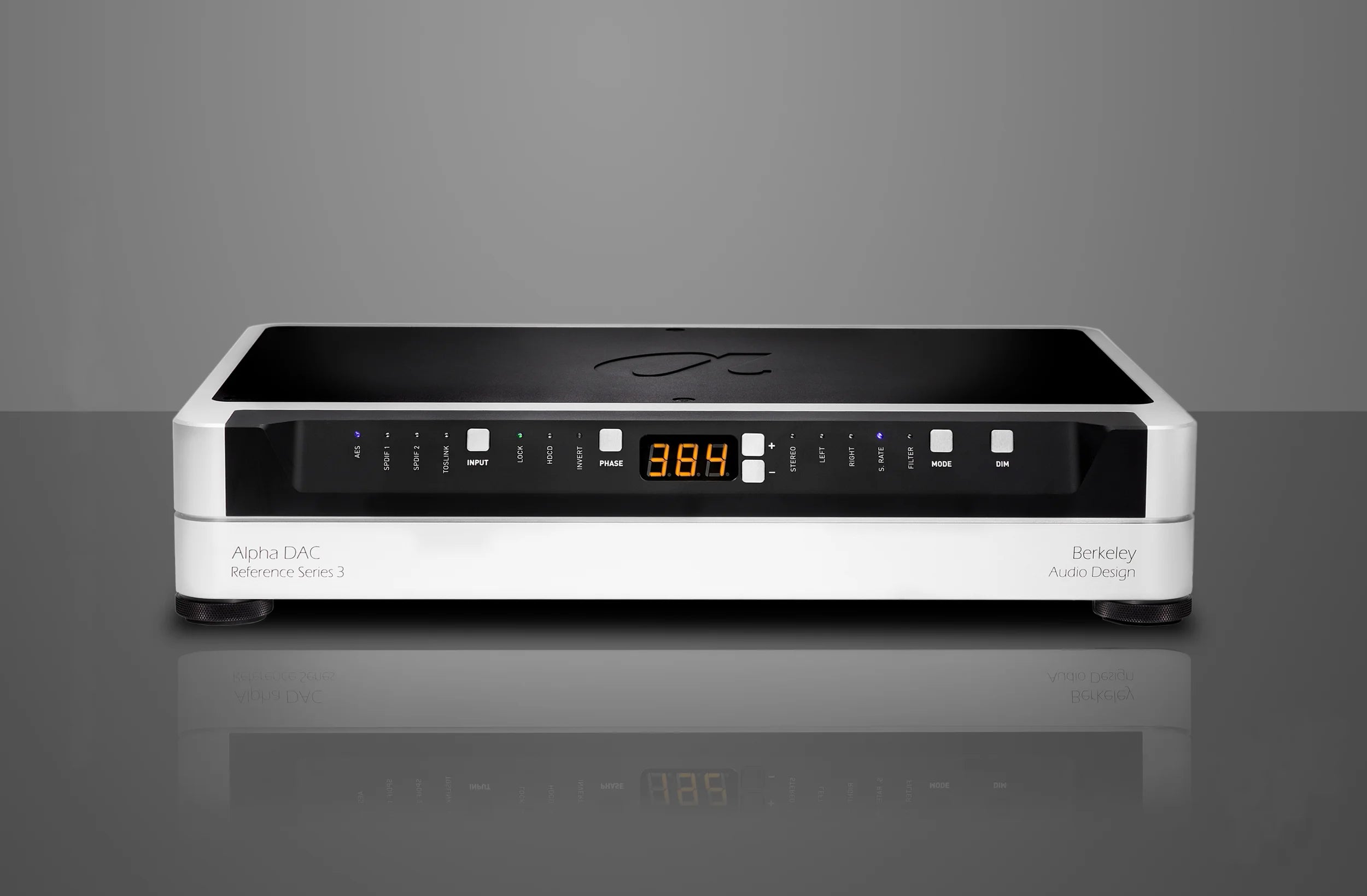
Berkeley Audio Design Alpha DAC Reference Series 3P Reference Digital-to-Analog Converter
The Berkeley Audio Design Alpha DAC Reference Series 3P is the company’s flagship reference digital-to-analog converter, engineered around exceptionally low time-domain distortion, ultra-low phase-noise precision clocking, proprietary RF isolation and extremely low-noise digital processing. Rather than chasing headline sampling-rate numbers, Berkeley concentrates on the accuracy of the conversion process itself—preserving transient information, spatial relationships, timbre and low-level musical detail. Berkeley Audio Design
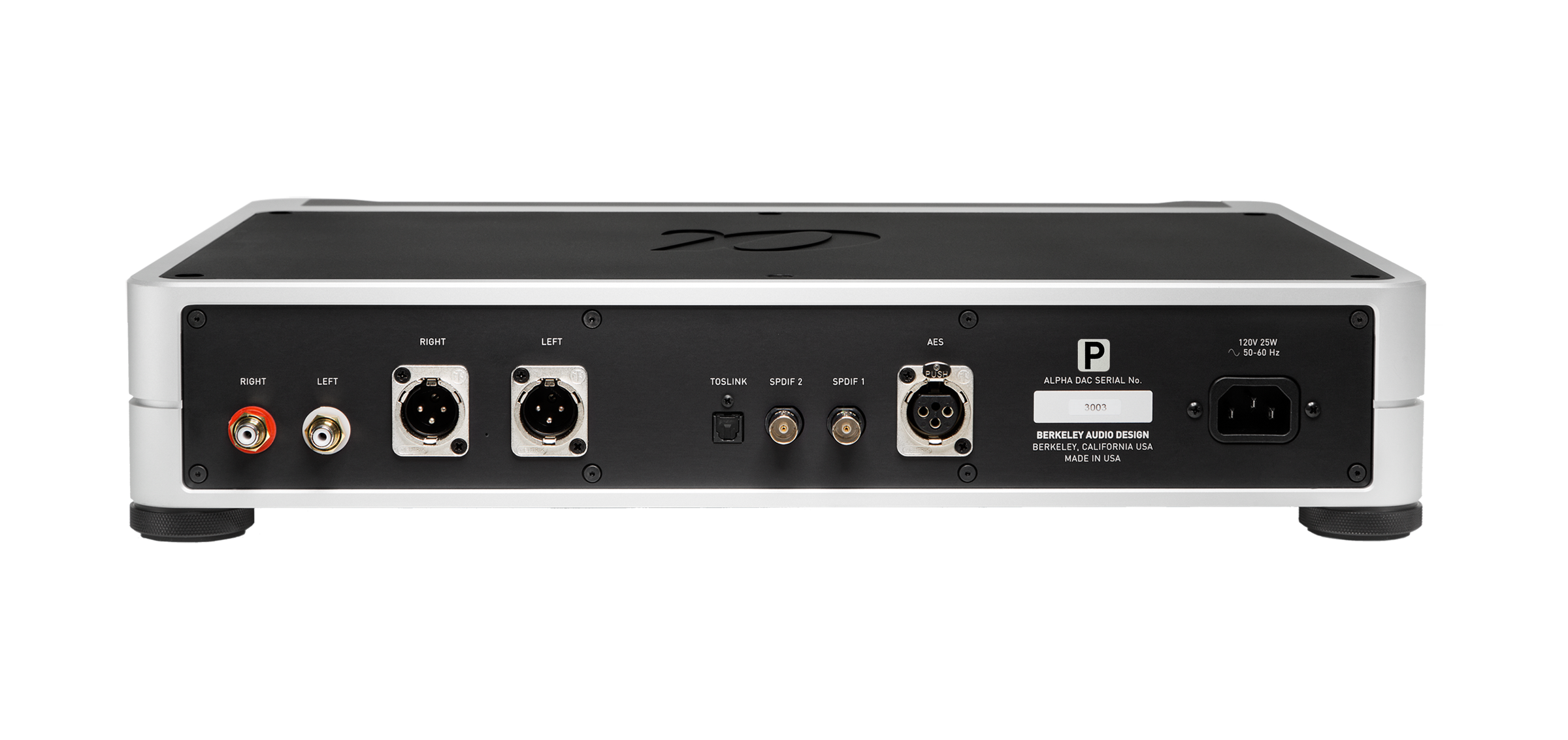
The Reference Series 3P accepts 24-bit PCM from 32kHz through 192kHz, provides AES/EBU, dual 75-ohm BNC S/PDIF and Toslink digital inputs, and delivers both balanced XLR and unbalanced RCA analog outputs. Its precision digital volume control also allows the DAC to connect directly to a power amplifier, eliminating a separate preamplifier when appropriate for the system. Berkeley Audio Design
Perfected Technology & Time-Domain Accuracy
The defining development in the Reference Series 3P is Berkeley Audio Design's Perfected Technology.
Berkeley's engineering focus is specifically on time-domain accuracy. The company argues that conventional distortion measurements do not fully describe the loss of transient, spatial and timbral information that can occur during digital conversion. The 3P platform therefore attacks noise, jitter, RF interference and timing errors throughout the signal path rather than relying on a single DAC-stage improvement. Berkeley Audio Design
The result is Berkeley's most advanced implementation of the Alpha DAC Reference architecture.
Proprietary RF Waveguide Isolation
A major advancement over the previous Reference Series 3 is Berkeley's new proprietary RF waveguide isolation technology.
The architecture is designed to prevent radio-frequency energy from contaminating sensitive conversion and analog circuitry. Berkeley specifically attributes the 3P's improvements in imaging precision, timbral purity and resolution to this new RF isolation technology. Berkeley Audio Design
This is not simply a firmware revision of the Series 3. The RF isolation implementation is one of the fundamental hardware changes behind the 3P designation.
Ultra-Low Phase-Noise Precision Clocking
Digital conversion depends heavily on accurate timing. Berkeley equips the Alpha DAC Reference Series 3P with ultra-low phase-noise precision clocking optimized for each supported PCM sample-rate family.
Precision clocking operates at:
44.1kHz • 48kHz • 88.2kHz • 96kHz • 176.4kHz • 192kHz
The specified input tolerance is ±100 ppm. Berkeley Audio Design
The objective is not merely maintaining digital lock, but reducing timing uncertainty before conversion so that transient structure and low-level spatial information are preserved.
AES/EBU, Dual BNC S/PDIF & Toslink Inputs
The Reference Series 3P provides four dedicated digital inputs:
- AES/EBU — 110Ω XLR
- S/PDIF 1 — 75Ω BNC
- S/PDIF 2 — 75Ω BNC
- Toslink optical
All support PCM input rates from 32kHz through 192kHz at up to 24-bit resolution. Berkeley Audio Design
Notably, Berkeley does not place a conventional USB input inside the Reference Series 3P. For USB-based music servers, Berkeley offers the separate Alpha USB Reference Series, which converts asynchronous USB to precision-clocked AES/EBU or BNC S/PDIF while providing extensive electrical isolation between the computer/server and DAC. Berkeley Audio Design
For a reference system, that separation keeps USB processing and its associated electrical environment physically outside the DAC chassis.
Balanced XLR & RCA Analog Outputs
The Reference Series 3P provides both balanced XLR and unbalanced RCA stereo outputs.
Maximum balanced output is:
+18dBu / 6.15Vrms
Berkeley recommends +12dBu / 3.1Vrms or lower for normal balanced operation.
Maximum unbalanced RCA output is:
3.25Vrms
Berkeley recommends 2Vrms or lower for normal unbalanced operation. Berkeley Audio Design
This adjustable output structure allows the DAC to integrate correctly with a wide range of preamplifiers and power amplifiers rather than forcing every system to operate at one fixed output voltage.
Direct-to-Amplifier Operation
The Alpha DAC Reference Series 3P incorporates a high-resolution digital volume and balance control with a 60dB operating range.
Volume adjustment is available in precise 0.1dB increments, while independent left/right gain trim provides 0.05dB resolution. Berkeley Audio Design
That precision allows the Reference Series 3P to function as the digital control center of a minimalist reference system, feeding a compatible power amplifier directly without requiring an additional analog preamplifier.
MQA Rendering
The Reference Series 3P includes MQA Rendering capability. Berkeley's current specification identifies MQA rendering along with multiple selectable digital-filter options. Berkeley Audio Design
Berkeley's documentation for the underlying Series 3 architecture specifies automatic detection of an MQA Core-decoded signal, with rendering extending to 384kHz and above. Berkeley Audio Design
This distinction matters: the Berkeley is an MQA Renderer, rather than being described by the manufacturer as a complete MQA decoder for a raw undecoded MQA stream.
HDCD Decoding
The Reference Series 3P also retains HDCD decoding.
Berkeley specifies detection of the 16-bit HDCD flag at 44.1kHz and the 24-bit flag at all supported sampling rates. Berkeley Audio Design
That makes HDCD functionality particularly useful for owners of large legacy CD and ripped-disc libraries containing HDCD-encoded recordings.
Multiple Digital Filter Options
Berkeley provides multiple selectable digital filters, allowing the reconstruction filter to be optimized according to source material and system preference. Berkeley Audio Design
The filter selection is integrated with the DAC's front-panel control and display architecture rather than requiring external software configuration.
Exceptional Low-Level Linearity & Distortion Performance
The Reference Series 3P's published measurements reflect Berkeley's focus on conversion accuracy.
At recommended output levels, Berkeley specifies distortion of:
≤ -120dBFS
At maximum output level:
THD+N < -110dBFS Berkeley Audio Design
At sample rates of 88.2kHz and above, frequency response is specified at ±0.1dB from below 0.1Hz to 35kHz, extending to -3dB at 59kHz with 176.4kHz and 192kHz source material. Berkeley Audio Design
Purpose-Built PCM Architecture
One unusual aspect of Berkeley's engineering philosophy is its treatment of DSD.
The Reference Series 3P is fundamentally a PCM DAC. Berkeley intentionally does not perform conventional DSD-to-multibit conversion inside the DAC. Instead, the company advocates extremely high-quality DSD-to-PCM conversion at the music server or computer before the signal reaches the DAC. Berkeley Audio Design
This keeps the additional DSD conversion processing—and its associated electrical activity—outside the DAC's sensitive conversion circuitry.
For Shopify and SEO, I would not describe the Reference Series 3P as a native DSD DAC. That would misrepresent Berkeley's deliberately different design philosophy.
Mechanically & Electrically Isolated Reference Construction
The Reference platform is built around extensive electrical, mechanical and thermal control. Berkeley uses aerospace-grade ceramic circuit-board materials in critical areas, while the enclosure is precision machined from solid billet 6061-T6 aluminum alloy. Berkeley Audio Design
The chassis weighs 30 pounds despite measuring only 17.5 inches wide, reflecting the substantial mechanical construction used to isolate the conversion circuitry.
Field-Upgradeable Firmware
Firmware is field upgradeable through the DAC's signal inputs, allowing Berkeley to update the digital platform without requiring conventional computer connectivity inside the component. Berkeley Audio Design
Berkeley also states that the previous Alpha DAC Reference Series 3 can be fully upgraded to Reference Series 3P specification, demonstrating the company's emphasis on maintaining the Reference platform over multiple generations. Berkeley Audio Design
Berkeley Audio Design Alpha DAC Reference Series 3P Technical Specifications
| Specification | Alpha DAC Reference Series 3P |
|---|---|
| Product Type | Reference Digital-to-Analog Converter / Digital Preamplifier |
| Input Format | PCM |
| Input Sampling Rate | 32kHz–192kHz |
| Input Word Length | 24-bit |
| Precision Clocking | Ultra-low phase-noise |
| Clocked Sample Rates | 44.1 / 48 / 88.2 / 96 / 176.4 / 192kHz |
| Input Tolerance | ±100 ppm |
| AES/EBU Input | 1 × XLR, 110Ω |
| S/PDIF Inputs | 2 × BNC, 75Ω |
| Optical Input | 1 × Toslink |
| USB Input | None — Alpha USB Reference Series available separately |
| Analog Outputs | Balanced XLR + Unbalanced RCA |
| XLR Polarity | Pin 2 positive |
| Maximum Balanced Output | +18dBu / 6.15Vrms |
| Recommended Balanced Output | +12dBu / 3.1Vrms or lower |
| Maximum RCA Output | 3.25Vrms |
| Recommended RCA Output | 2Vrms or lower |
| Volume Resolution | 0.1dB steps |
| L/R Gain Trim | 0.05dB steps |
| Volume Range | 60dB |
| MQA | MQA Rendering |
| HDCD | Yes |
| Digital Filters | Multiple selectable options |
| Frequency Response ≥88.2kHz | ±0.1dB, <0.1Hz–35kHz |
| HF Extension at 176.4/192kHz | -3dB at 59kHz |
| Distortion at Recommended Levels | ≤ -120dBFS |
| THD+N at Maximum Level | < -110dBFS |
| Firmware | Field upgradeable through signal inputs |
| Chassis Material | Precision-machined 6061-T6 aluminum |
| Dimensions | 17.5"W × 12.5"D × 3.5"H |
| Weight | 30 lb |
| AC Mains | 100 / 120 / 240VAC, 50/60Hz |
| Power Consumption | 25W |
Specifications are based on Berkeley Audio Design's current Reference Series 3P product information. Berkeley Audio Design
Reference Series 3P + Alpha USB Reference Series
For a server such as an Aurender N50, N30SA or N20, the Reference Series 3P can be connected directly using AES/EBU or 75Ω BNC S/PDIF. For USB-only or computer-based sources, Berkeley's Alpha USB Reference Series provides the dedicated USB interface.
The Alpha USB Reference Series accepts asynchronous USB Audio 2.0 and outputs either 110Ω AES/EBU or 75Ω BNC S/PDIF, supporting up to 24-bit/192kHz. Its USB input circuitry and digital-output circuitry are electrically isolated, with the output clock and line drivers powered from a separate isolated linear supply. Berkeley Audio Design
That pairing is important for customers comparing the Berkeley with DACs that simply include USB internally: Berkeley deliberately treats the USB interface as a separate precision component rather than adding it inside the Reference DAC.
Berkeley Audio Design Alpha DAC Reference Series 3P at The Grid HiFi
The Berkeley Audio Design Alpha DAC Reference Series 3P is built for digital systems where conversion accuracy, clocking, electrical isolation and system architecture take priority over feature count. Pair it with a reference music server such as Aurender N50 or N30SA, premium amplification and a properly engineered digital connection to create an exceptionally focused high-end digital front end.
The Grid HiFi can design the complete Berkeley Audio Design system around the appropriate music server, AES/EBU or BNC digital connection, preamplifier or direct-amplifier configuration, amplification and loudspeakers.
Considering the Alpha DAC Reference Series 3P? Call The Grid HiFi at (713) 218-8120 to build the complete reference digital system around it.
FAQs
Please read our FAQs page to find out more.
Do you price match?
Yes. We match any authorised dealer, including big-box retailers. If you find the same product at a lower price, contact us and we'll match it.
Do you offer free shipping?
Yes — free shipping on every order, with 2-day delivery available on most products. Easy returns and exchanges are included.
Where is your showroom?
We're at 6362 Alder Drive, Houston, Texas. The showroom lets you hear and compare reference-level systems in person before making any decisions. If you're considering a larger purchase or installation, it's well worth the visit.
Can I buy online without visiting the showroom?
Yes. The full product range is available through the online store with free nationwide shipping. For more complex system builds, speaking with one of our advisers first tends to lead to a better result.
Do you offer financing?
Yes. Special financing is available through the BrandSource Credit Card for qualifying purchases, allowing you to spread payments over time with no annual fee. Promotional rebate savings are also available periodically. See the financing page for full details.
Do you install systems as well as sell equipment?
Yes — installation is central to what we do. We design and install whole-home audio and video, home theaters, media rooms, outdoor audio, lighting and motorised shades, and full smart home automation.
Do you provide support after installation?
Yes. We provide ongoing service and support to ensure systems continue performing as intended — not just on installation day, but over the long term.