




Berkeley Audio Design Alpha DAC Series 3 | The Grid HiFi
Pairs well with
Berkeley Audio Design Alpha DAC Series 3 | The Grid HiFi
If you have any questions, you are always welcome to contact us. We'll get back to you as soon as possible, within 24 hours on weekdays.
-
Shipping Information
Use this text to answer questions in as much detail as possible for your customers.
-
Customer Support
Use this text to answer questions in as much detail as possible for your customers.
-
FAQ’s
Use this text to answer questions in as much detail as possible for your customers.
-
Contact Us
Use this text to answer questions in as much detail as possible for your customers.
Overview
Berkeley Audio Design Alpha DAC Series 3 Digital-to-Analog Converter
The Berkeley Audio Design Alpha DAC Series 3 is a reference-grade PCM digital-to-analog converter and digital preamplifier derived from technology developed for Berkeley’s flagship Alpha DAC Reference Series 3. Its architecture emphasizes ultra-low phase-noise conversion clocking, exceptionally low distortion, precision digital level control and accurate reproduction of low-level spatial and timbral information rather than maximizing format specifications. Berkeley Audio Design
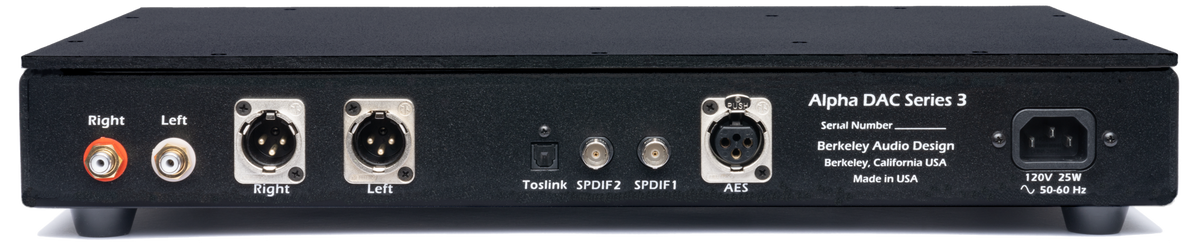
Supporting 24-bit PCM from 32kHz through 192kHz, MQA Rendering beyond 384kHz and HDCD decoding, the Alpha DAC Series 3 provides AES/EBU, dual 75Ω BNC S/PDIF and Toslink inputs with balanced XLR and unbalanced RCA analog outputs. Its variable output can also connect directly to a compatible power amplifier, allowing the Series 3 to serve as both DAC and digital system controller. Berkeley Audio Design
Reference Series Technology
Berkeley developed the Alpha DAC Series 3 as a more accessible implementation of technology originating in the Alpha DAC Reference Series 3.
The focus is on resolving extremely low-level information while maintaining image separation, dimensionality, tonal density and clarity in complex recordings. Rather than adding unnecessary connectivity and processing inside the chassis, Berkeley concentrates the design around the digital conversion and analog output stages. Berkeley Audio Design
Ultra-Low Phase-Noise Precision Clocking
The Alpha DAC Series 3 uses ultra-low phase-noise precision conversion clocks optimized for each supported PCM sample-rate family:
44.1kHz • 48kHz • 88.2kHz • 96kHz • 176.4kHz • 192kHz
Berkeley specifies a clock input tolerance of ±100 ppm. Berkeley Audio Design
Clocking is a central part of Berkeley's design philosophy because timing errors can compromise transient structure, spatial information and low-level detail even when conventional frequency-domain measurements remain excellent.
AES/EBU, Dual BNC & Toslink Digital Inputs
The Alpha DAC Series 3 provides four dedicated digital inputs:
- 1 × AES/EBU — 110Ω XLR
- 2 × S/PDIF — 75Ω BNC
- 1 × Toslink optical
All accept PCM with sampling rates from 32kHz through 192kHz and word lengths up to 24-bit. Berkeley Audio Design
This makes the Series 3 particularly well suited to high-end music servers and digital transports with precision AES/EBU or true 75Ω BNC digital outputs.
No Conventional USB Input
The Alpha DAC Series 3 deliberately does not include a USB input.
For USB-equipped music servers and computers, Berkeley designed the separate Alpha USB Series 2 interface. It accepts asynchronous USB Audio 2.0 and converts it to either 110Ω AES/EBU or 75Ω BNC S/PDIF, supporting up to 24-bit/192kHz. Berkeley Audio Design
This keeps the USB receiver, processing and associated computer-side electrical activity physically outside the DAC chassis rather than integrating another potentially noisy interface into the converter.
Balanced XLR & RCA Analog Outputs
The Series 3 provides both balanced XLR and unbalanced RCA stereo analog outputs.
Maximum balanced output is:
+18dBu / 6.15Vrms
Berkeley recommends +12dBu / 3.1Vrms or lower for normal balanced operation.
Maximum unbalanced RCA output is 3.25Vrms, with 2Vrms or lower recommended. Balanced XLR wiring uses Pin 2 positive. Berkeley Audio Design
The wide output-level capability makes the DAC compatible with conventional line preamplifiers as well as direct connection to appropriate power amplifiers.
Precision Digital Volume & Balance Control
The Alpha DAC Series 3 incorporates a high-resolution digital volume and balance control with a total 60dB operating range.
Volume can be adjusted in precise 0.1dB increments, while independent left/right gain trim operates in 0.05dB steps. Berkeley Audio Design
This provides unusually fine system-level matching and enables the Series 3 to operate as a digital preamplifier in systems built entirely around digital sources.
Direct-to-Power-Amplifier Operation
Berkeley specifically designed the Series 3 outputs for the option of connecting directly to a power amplifier. Berkeley Audio Design
A minimalist digital system can therefore be configured as:
Music Server → Alpha DAC Series 3 → Power Amplifier → Loudspeakers
For systems that also require analog sources, the Series 3 can instead feed a conventional high-end preamplifier at an appropriate fixed output level.
MQA Rendering Beyond 384kHz
The Series 3 automatically recognizes an MQA Core-decoded signal and performs the subsequent MQA rendering process to 384kHz and above. Berkeley Audio Design
This terminology matters for an accurate listing: the Alpha DAC Series 3 is an MQA Renderer, rather than a complete first-stage decoder of an untouched MQA stream.
HDCD Decoding
The Alpha DAC Series 3 also incorporates HDCD decoding, a useful feature for high-end systems built around extensive CD and ripped-disc libraries.
Berkeley specifies detection of the 16-bit HDCD flag at 44.1kHz and the 24-bit flag at all supported sample rates. Berkeley Audio Design
Multiple Digital Filter Options
Multiple selectable digital reconstruction filters allow the Series 3's conversion behavior to be adjusted from the front panel.
The three-digit display can show stereo/left/right attenuation, sampling rate and selected filter type, while additional controls provide input selection, absolute phase inversion and multiple display brightness levels. Berkeley Audio Design
Exceptional Distortion Performance
Berkeley specifies distortion at recommended analog output levels at:
≤ -120dBFS
At maximum output:
THD+N < -110dBFS
At sampling rates of 88.2kHz and above, frequency response is rated at ±0.1dB from below 0.1Hz to 35kHz. With 176.4kHz and 192kHz source material, response extends to -3dB at 59kHz. Berkeley Audio Design
These figures reinforce the Series 3's design priority: extremely accurate conversion and analog output rather than a long list of additional functions.
PCM-Focused Digital Architecture
The Alpha DAC Series 3 is fundamentally a 24-bit PCM DAC. Berkeley specifies PCM inputs from 32kHz through 192kHz and does not advertise native DSD or DoP input. Berkeley Audio Design
For an SEO-accurate Shopify listing, I would therefore not describe the Alpha DAC Series 3 as a DSD DAC.
Berkeley's broader design philosophy has been to perform DSD-to-PCM conversion upstream when required rather than add additional conversion processing inside its DAC. The goal is to keep unnecessary processing activity away from the sensitive D/A conversion circuitry. Berkeley Audio Design
All-Metal IR Remote & Front-Panel Control
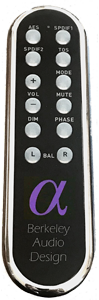
The Series 3 includes an all-metal IR remote control and provides comprehensive front-panel operation.
Controls and indicators include input selection, digital lock status, HDCD detection, absolute phase, attenuation, sampling rate, digital-filter selection and display brightness. Berkeley Audio Design
Firmware can also be upgraded through the signal inputs, eliminating the need for a conventional computer interface inside the DAC. Berkeley Audio Design
Berkeley Audio Design Alpha DAC Series 3 Technical Specifications
| Specification | Alpha DAC Series 3 |
|---|---|
| Product Type | High-End DAC / Digital Preamplifier |
| Input Format | PCM |
| Input Sampling Rate | 32kHz–192kHz |
| Input Word Length | 24-bit |
| Precision Clocking | Ultra-Low Phase Noise |
| Clocked Sample Rates | 44.1 / 48 / 88.2 / 96 / 176.4 / 192kHz |
| Clock Tolerance | ±100 ppm |
| AES/EBU Input | 1 × XLR, 110Ω |
| S/PDIF Inputs | 2 × BNC, 75Ω |
| Optical Input | 1 × Toslink |
| USB Input | None |
| Analog Outputs | Balanced XLR + Unbalanced RCA |
| XLR Polarity | Pin 2 Positive |
| Maximum Balanced Output | +18dBu / 6.15Vrms |
| Recommended Balanced Output | +12dBu / 3.1Vrms or lower |
| Maximum RCA Output | 3.25Vrms |
| Recommended RCA Output | 2Vrms or lower |
| Volume Control | Digital, 0.1dB steps |
| Left/Right Gain Trim | 0.05dB steps |
| Attenuation Range | 60dB |
| Direct Power Amplifier Connection | Yes |
| MQA | MQA Renderer |
| MQA Rendering | 384kHz and above |
| HDCD Decoding | Yes |
| Digital Filters | Multiple selectable filters |
| Absolute Phase | Selectable normal/inverted |
| Frequency Response ≥88.2kHz | ±0.1dB, <0.1Hz–35kHz |
| HF Extension at 176.4/192kHz | -3dB at 59kHz |
| Distortion at Recommended Levels | ≤ -120dBFS |
| THD+N at Maximum Output | < -110dBFS |
| Firmware | Upgradeable through signal inputs |
| Remote | All-metal Series 3 IR remote |
| Dimensions | 16.7"W × 10.6"D × 2.3"H |
| Weight | 11.6 lb |
| Mains Power | 100 / 120 / 240VAC, 50/60Hz |
| Power Consumption | 25W |
These specifications follow Berkeley Audio Design's current Series 3 product page. Berkeley Audio Design
Series 3 vs. Series 3P
This distinction is important now that both products remain available.
The Alpha DAC Series 3P is the newer evolution, adding Berkeley's Perfected Technology, including proprietary RF waveguide technology, new ultra-low-noise reclocking and new extremely low-noise software aimed specifically at improving time-domain accuracy. Berkeley states that the original Series 3 continues to be available and can be factory upgraded to Series 3P specification. Berkeley Audio Design
Interestingly, their published headline specifications are otherwise extremely similar: both support 24-bit/192kHz PCM, MQA Rendering, HDCD, the same input complement, variable XLR/RCA outputs, 60dB digital attenuation and the same published distortion and frequency-response figures. The 3P's advancement is therefore principally in the implementation and reduction of time-domain/RF noise, not a higher advertised PCM sampling rate or additional connectivity. Berkeley Audio Design
That distinction should help the two Shopify pages rank separately without making the Series 3 description look like a duplicate of the 3P page.
Alpha DAC Series 3 at The Grid HiFi
The Berkeley Audio Design Alpha DAC Series 3 is an exceptional match for a dedicated high-end digital transport. Its AES/EBU and true 75Ω BNC inputs make it particularly well suited to Aurender music servers such as the N20, N30SA and N50, where the complete digital interface can be optimized around the Berkeley rather than defaulting to USB.
The Grid HiFi can build the complete digital front end around the Alpha DAC Series 3, including the music server, digital interface, preamplifier or direct-to-amplifier configuration, cabling, amplification and loudspeakers.
Considering the Berkeley Alpha DAC Series 3? Call The Grid HiFi at (713) 218-8120 to build the complete reference digital system around it.
FAQs
Please read our FAQs page to find out more.
Do you price match?
Yes. We match any authorised dealer, including big-box retailers. If you find the same product at a lower price, contact us and we'll match it.
Do you offer free shipping?
Yes — free shipping on every order, with 2-day delivery available on most products. Easy returns and exchanges are included.
Where is your showroom?
We're at 6362 Alder Drive, Houston, Texas. The showroom lets you hear and compare reference-level systems in person before making any decisions. If you're considering a larger purchase or installation, it's well worth the visit.
Can I buy online without visiting the showroom?
Yes. The full product range is available through the online store with free nationwide shipping. For more complex system builds, speaking with one of our advisers first tends to lead to a better result.
Do you offer financing?
Yes. Special financing is available through the BrandSource Credit Card for qualifying purchases, allowing you to spread payments over time with no annual fee. Promotional rebate savings are also available periodically. See the financing page for full details.
Do you install systems as well as sell equipment?
Yes — installation is central to what we do. We design and install whole-home audio and video, home theaters, media rooms, outdoor audio, lighting and motorised shades, and full smart home automation.
Do you provide support after installation?
Yes. We provide ongoing service and support to ensure systems continue performing as intended — not just on installation day, but over the long term.